TL;DR:
- Galaxy Digital identified seven Democratic senators as key figures to advance the Clarity Act in the Senate Banking Committee vote.
- Two legislators are favorable to the crypto framework, four are conditional negotiators, and one is considered undecided.
- The bill needs at least 60 votes on the Senate floor and bipartisan support to become active federal legislation.
Galaxy Digital published on Sunday an analysis identifying seven Democratic senators on the United States Senate Banking Committee as determining figures for the advancement of the Digital Asset Market Clarity Act, whose markup is scheduled for next Thursday. According to the firm, if Democrats vote in favor at that stage, “the probability of final approval on the Senate floor increases significantly”.
The Clarity Act was introduced in July 2025 with the goal of establishing clear federal rules for the crypto industry in the United States, which would reduce years of regulatory uncertainty and create more favorable conditions for the development of projects in the country.
However, the bill stalled in January when Coinbase withdrew its support, citing the absence of legal protections for open-source software developers, the prohibition of yields on stablecoins, and provisions on decentralized finance. The true objective must not be lost sight of: regulatory clarity and predictability stand at opposite ends from abusive state control.
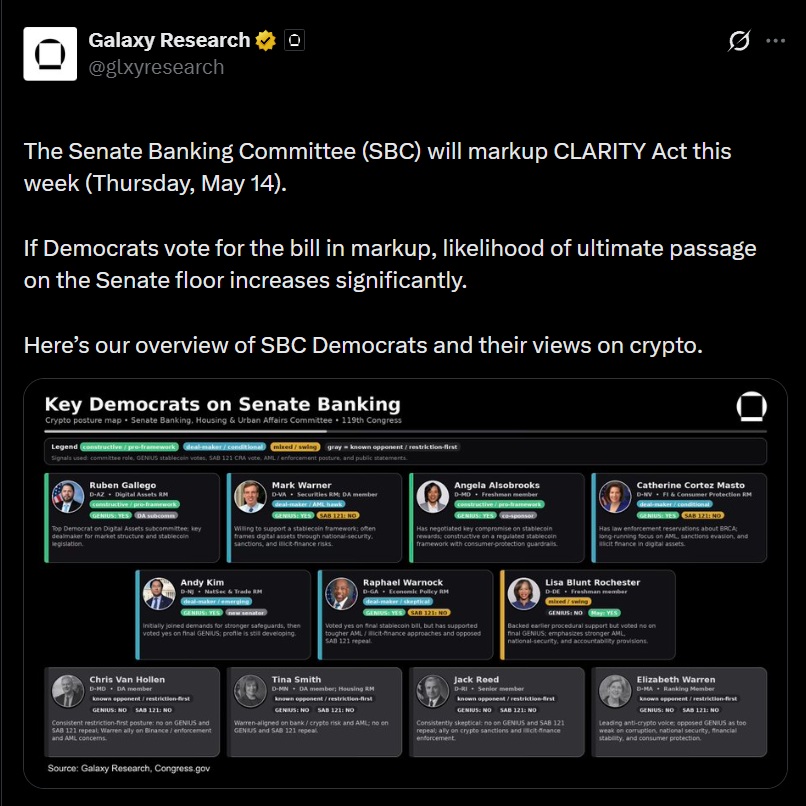
The Democrats Who Can Tip the Balance
Galaxy classified Ruben Gallego and Angela Alsobrooks as “constructive and favorable to the regulatory framework.” It placed Mark Warner, Catherine Cortez Masto, Andy Kim, and Raphael Warnock as “conditional negotiators”: legislators who voted in favor of the GENIUS Act and who, while supporting a framework for cryptocurrencies, demand stricter guarantees against illicit financing and money laundering. Lisa Blunt Rochester was categorized as “mixed” and is considered a swing vote: she backed the crypto framework but voted against the GENIUS Act.
At the opposite end, Galaxy anticipated that Jack Reed, Elizabeth Warren, Tina Smith, and Chris Van Hollen will vote against, in line with their public positions and their prior rejection of the GENIUS Act.

The Clarity Act Needs Bipartisan Consensus
To clear the Banking Committee, the Clarity Act requires at least 12 of the 24 votes from the group, composed of 13 Republicans and 11 Democrats. Kara Calvert, Vice President of Policy at Coinbase for the United States, noted at the Consensus 2026 conference that the bill needs a minimum of 60 votes on the Senate floor to succeed, making the construction of bipartisan consensus essential. The platform Stand With Crypto rates Warner, Cortez Masto, and Alsobrooks as strongly favorable to cryptocurrencies, while Reed, Warren, and Smith appear as strongly opposed.