TL;DR
- South Korea plans a tokenized deposit pilot for government operational spending, with rollout targeted for Q4 2026 and an initial launch in Sejong City.
- The sandbox will test programmable limits on timing, categories, and usage, aiming to improve oversight, traceability, and control over public-sector expenses.
- Officials see the project as part of a roadmap after an earlier subsidy pilot and a goal to digitize one-quarter of treasury execution by 2030.
South Korea is preparing to test tokenized deposits for public-sector spending, in a move that could turn a narrow payments pilot into a broader rethink of how governments monitor and distribute money. What makes the initiative notable is that it brings programmable payments into the machinery of day-to-day state operations. The Ministry of Economy and Finance selected the project under a regulatory sandbox for distributed ledger-based financial infrastructure, with a full rollout targeted for the fourth quarter of 2026 and an initial launch in Sejong City.
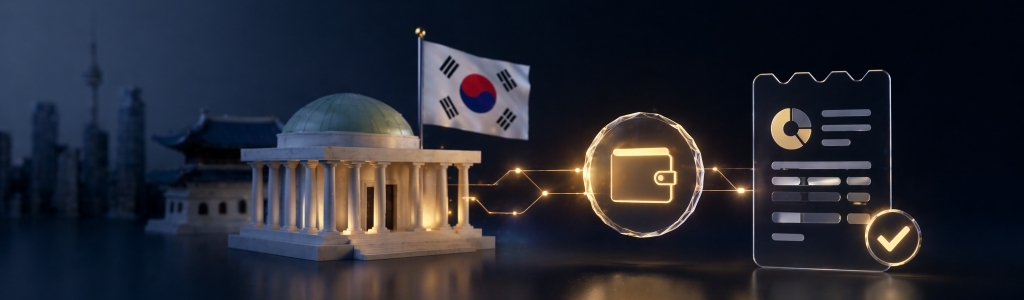
The pilot will focus on government operational expenses, an area still handled through government-issued credit and debit cards followed by post-use reporting. That legacy process is precisely what the new model is trying to challenge. Under the trial, tokenized deposits will carry preset conditions such as spending windows, category restrictions, and usage limits, allowing authorities to test whether programmable money can improve traceability and reduce misuse. The sandbox will also let participating institutions define the trial’s scope before officials decide whether broader legal or regulatory changes are needed.
A Payments Experiment With Wider Fiscal Implications
At the center of the project is a specific type of digital money that stays close to the traditional banking system. Unlike many stablecoins, tokenized deposits remain bank liabilities and are designed to function inside existing financial rails rather than outside them. That distinction matters because the government is not testing a parallel monetary system, but a more programmable version of the one it already uses. If the model works, officials see it as a possible basis for evaluating new payment and settlement methods across broader fiscal operations. It would test whether compliance controls can be embedded effectively before funds are spent.
The experiment also builds on an earlier policy direction rather than appearing out of nowhere. South Korea is moving tokenized payments from subsidy distribution toward routine government spending, which makes this pilot feel more structural than symbolic. On March 19, authorities announced a separate use of tokenized deposits for electric-vehicle charging infrastructure subsidies in cooperation with the Environment Ministry and the Bank of Korea. At that time, the finance ministry said it aimed to convert one-quarter of treasury fund execution to digital currency by 2030, suggesting this latest trial is part of a longer institutional roadmap.