TL;DR:
- Armstrong publicly backed the Clarity Act after months in which Coinbase had refused to support earlier versions of the bill.
- Brian Armstrong reacted to an opinion piece by Treasury Secretary Scott Bessent, who urged Congress to move forward with regulation.
- TD Cowen analysts warn that political divisions could complicate the advancement of crypto legislation in Congress.
United States Treasury Secretary Scott Bessent published an opinion column in The Wall Street Journal urging Congress to move swiftly on digital asset regulation. The response came quickly: Brian Armstrong, CEO of Coinbase, publicly backed the initiative and stated it was time to pass the Clarity Act.
“We agree. Thank you, Secretary Scott Bessent, for saying so. It’s time to pass the Clarity Act,” Armstrong wrote, also expressing gratitude for “all the bipartisan work among senators and their teams over the past few months to turn this into a solid bill.”
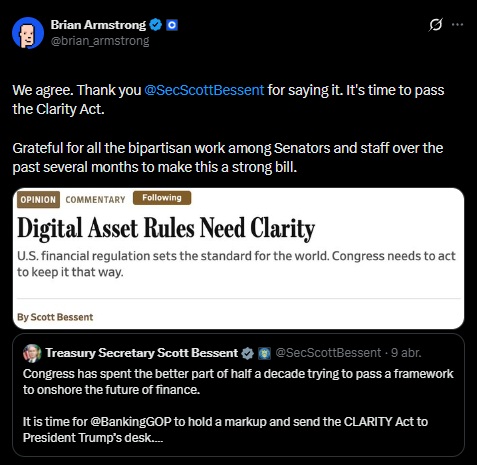
Armstrong Acknowledges the Bipartisan Work
Armstrong’s positioning marks a clear shift for the company. Earlier this year, Coinbase had refused to support earlier versions of the bill, primarily due to disagreements over stablecoin provisions, particularly those related to the yield these assets could generate.
The most recent signal of openness had come from Paul Grewal, Coinbase’s Chief Legal Officer, who stated that the bill was “very close” to reaching an agreement on those points, suggesting progress in behind-the-scenes negotiations.

The Clarity Act aims to establish a comprehensive regulatory framework for cryptocurrency markets in the United States, including a specific structure for stablecoins. Bessent argued in his column that “digital asset rules need clarity,” and that Congress has a responsibility to act.
However, several factors remain unresolved. TD Cowen analysts warned that recent White House findings on stablecoins are unlikely to reduce existing political divisions and could complicate progress on the legislation. Adding to that, Treasury officials are also evaluating new proposals related to anti-money laundering and sanctions risks associated with stablecoin issuers, which could introduce further complexity to the debate. Coinbase, for its part, has not issued any formal policy update.