TL;DR:
- David Schwartz, key architect of the XRPL, ruled out launching an independent project and attributed his decision to being “too lazy.”
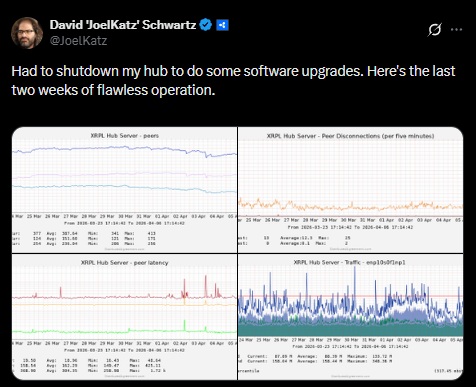
- He published performance data from his personal node and exposed a bug where servers in the same data center can trigger anti-DDoS protections by operating with minimal latency.
- Although he transitioned to the role of CTO Emeritus in late 2025, Schwartz remains involved in the development and stability of the protocol.
David Schwartz, CTO Emeritus at Ripple and one of the original designers of the XRPL, moved to dispel rumors circulating in the XRP community about a possible independent venture. His response was concise and characteristic of his style: he said he was “too lazy” to launch his own startup. The statement carried his usual ironic tone and shut down the speculation that had been circulating since Schwartz formalized his transition to the role of CTO Emeritus in late 2025.
Far from stepping aside, Schwartz remains active within the ecosystem. He is not building a new project from scratch, but rather working on the existing foundation of the XRP Ledger and contributing to the operational stability of the network.
A Bug Born from Efficiency
This week, Schwartz published for the first time in a long while performance data from his personal XRPL node covering the past 14 days. The publication triggered an in-depth technical debate about imperfections in the `rippled` codebase, the software on which the XRP Ledger runs.
The exchange surfaced a paradoxical finding: two servers located in the same data center can operate with such low latency that the XRPL’s own protection algorithm interprets that high-speed data exchange as a DDoS attack and terminates the connection. In other words, the system penalizes extreme efficiency by mistaking it for a threat. David acknowledged the existence of the problem, also with irony.

Schwartz Has No Intention of Fragmenting the Ripple Ecosystem
With the token XRP currently trading around $1.30 and the legal disputes with the SEC firmly in the past, Schwartz remains, de facto, the central technical reference of the protocol. His decision not to divert efforts into a parallel project can be read as a signal of continuity for investors: the chief architect of Ripple has no intention of splitting the market’s attention or the liquidity of the ecosystem he has spent more than a decade building.