TL;DR
- Market Outlook: LGNS shows wide valuation ranges from 2026–2032, shaped by liquidity depth, Polygon integrations, and evolving on‑chain activity.
- Ecosystem Drivers: Growth depends on governance reliability, developer consistency, and real utility across automated strategies and Polygon‑based products.
- Long‑Term Potential: Forecasts span conservative to highly optimistic scenarios, with higher targets tied to transparency, integrations, and sustained protocol development.
Origin LGNS is a modular DeFi and infrastructure project deployed on Polygon, designed to connect liquidity, yield strategies, and on‑chain tools under a single coordinated ecosystem. Instead of acting as a standalone application, Origin LGNS functions as a base layer for vaults, structured products, and automated strategies that can plug into existing Polygon liquidity.
By building on Polygon’s low‑fee, high‑throughput environment, the protocol targets active traders, yield farmers, and protocols that require efficient execution without sacrificing composability. Its architecture is oriented toward capital efficiency and automation, allowing strategies to be created, rebalanced, and scaled with minimal friction while still remaining transparent and fully on‑chain.
The role of the LGNS token in the ecosystem
The LGNS token is the core asset of the Origin ecosystem, aligning incentives between users, strategists, and protocol governance. It is built on the ERC-20 token standard. It is used for fee capture, staking, and governance proposals that determine how new strategies are launched, how risk parameters are tuned, and how treasury resources are allocated over time. On Polygon, LGNS also acts as a routing and rewards layer, directing emissions or incentives toward the most relevant liquidity pools and products.
This gives the token a direct link to real protocol activity rather than purely speculative demand. For a price prediction framework, LGNS must therefore be evaluated through metrics such as total value locked, fee generation, token emissions, and governance decisions, all of which influence how the market may value future cash‑flow potential and ecosystem growth over the 2026–2032 analysis timeframe.
Origin LGNS 2026, 2027, 2028, 2029, 2030, 2031, and 2032 Price Prediction
2026 Origin LGNS: Early Market Structure Overview
According to CoinDataFlow, the token could fluctuate between $1.16 on the lower end and $6.07 on the upper end, a range that implies a potential 23.18% increase in its average valuation if the market aligns with the forecast. These estimates highlight how sensitive the asset remains to liquidity depth, user participation, and broader market sentiment.
Other outlooks for 2026 paint a more aggressive scenario, driven by expectations of stronger on‑chain metrics and rising transaction volumes. Under these conditions, some projections place the asset between $30 and $38, a range that assumes accelerated adoption and more consistent protocol usage.
2027 Origin LGNS: Shifts in Network Activity
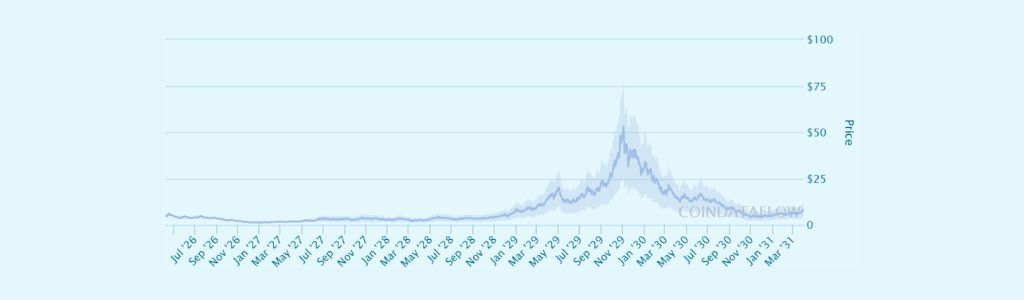
CoinCodex projects that LGNS could move within a channel between $6.28 and $12.80, settling around an annualized average near $8.30. If these estimates materialize, the token would be positioned for a potential 160.21% return, reflecting stronger liquidity, deeper participation, and a more stable user base.
A separate outlook for 2027 leans toward a more ambitious scenario, driven by the possibility of LGNS securing a clearer role within the Polygon ecosystem. Under these conditions, some projections place the asset between $40 and $52, a range that assumes stronger adoption and more consistent protocol usage.
2028 Origin LGNS: Ecosystem Growth Indicators
DigitalCoinPrice projects that LGNS could begin the year near $7.26 and stabilize around $8.29, a level that would represent a meaningful improvement compared to the prior cycle. This anticipated rise reflects growing confidence in Origin’s modular framework and the expanding role of Polygon‑based infrastructure in supporting scalable DeFi activity.
A different segment of the market envisions a far more assertive performance for the asset by 2028, driven by regulatory clarity and stronger accountability across decentralized platforms. If Origin maintains active development, strengthens its governance processes, and continues to demonstrate verifiable on‑chain activity, the token could sustain valuations in the $45 to $55 range.
2029 Origin LGNS: Liquidity and Utility Dynamics
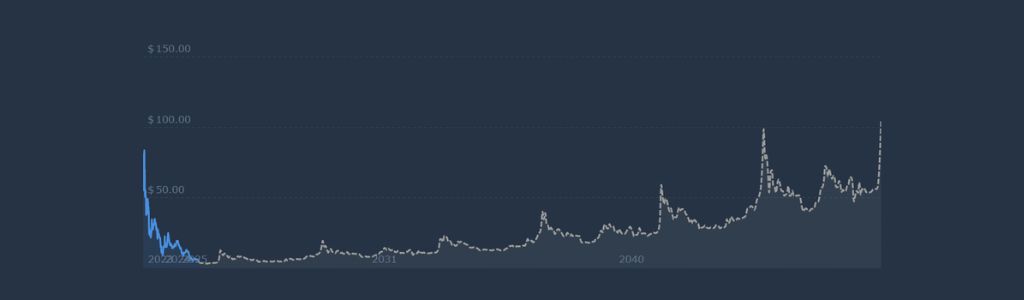
Projections for 2029 point to a more restrained trading environment for the asset, reflecting a phase where market participants reassess risk and utility across the broader DeFi landscape. Experts estimate that LGNS could fluctuate between $4.56 and $6.79, with an annualized average near $5.73. This range suggests a potential 38.08% return.
Looking beyond the conservative outlook, some analysts argue that 2029 could become a pivotal year for the network’s native asset if it succeeds in embedding itself deeper into Polygon’s expanding application layer. Integrations with established dApps, liquidity partners, or automated strategy platforms could significantly elevate its relevance, potentially pushing valuations into the $55 to $70 range.
2030 Origin LGNS: Adoption and Protocol Expansion
Expectations for 2030 point toward a potentially transformative phase for the network’s native asset, as several long‑term models anticipate a stronger market presence and improved capitalization. Some forecasts suggest that LGNS could surpass $10.67, with projected movement between $8.31 and $10.67 over the five‑year window leading into 2030.
A more optimistic interpretation of 2030 centers on the widening gap between utility‑driven assets and speculative tokens. Should Origin maintain a steady cadence of updates, secure meaningful partnerships, and eliminate lingering contract risks, the asset could command valuations in the $60 to $85 range.
2031 Origin LGNS: Long‑Term Performance Signals
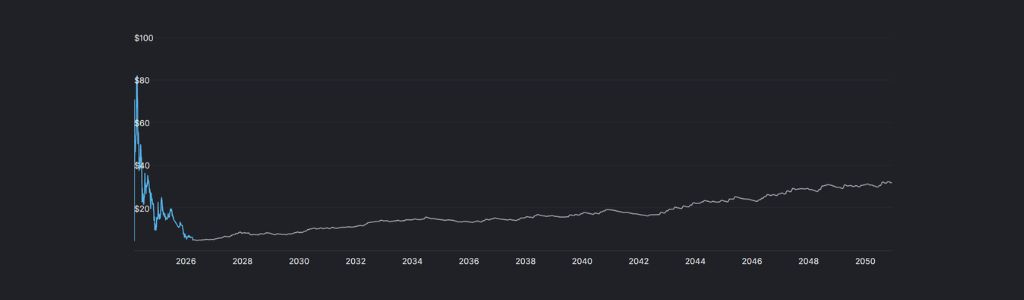
Forecast models for 2031 suggest that the network’s native asset could experience a notable expansion phase, supported by experimental simulations that point to a potential 186.19% increase. These projections indicate that LGNS might reach $14.10 in an ideal performance window, while broader trading activity could fluctuate between $5.12 and $14.10 throughout the year.
Additional technical analysis from market researchers presents a more moderate outlook, emphasizing steady progression rather than explosive growth. Their models suggest that the asset could surpass $10.77, with expectations placing the lower boundary near $10.21 and a potential ceiling around $11.15.
2032 Origin LGNS: Maturity and Market Positioning
The outlook for 2032 points to a more measured but meaningful progression for the network’s native asset, with long‑term models suggesting a valuation range shaped by steady ecosystem development. Some analyses indicate that Origin LGNS may reach $12.79 at both the beginning and end of the year, while additional projections note that the asset could touch $11.43 during periods of market fluctuation.
A separate set of experimental models outlines a far more aggressive trajectory, highlighting the possibility of a 578.02% increase if the most favorable scenario unfolds. In this outlook, Origin LGNS could climb toward $33.42, with trading activity expected to fluctuate between $7.51 and $33.42 throughout the year.
Conclusion
Across 2026–2032, LGNS shows a wide spectrum of potential outcomes, shaped by liquidity depth, Polygon integrations, governance reliability, and ecosystem maturity. Its long‑term trajectory ultimately depends on sustained development, real utility, and measurable on‑chain activity as the Origin framework continues to evolve.
The Price Predictions published in this article are based on estimates made by industry professionals; they are not investment recommendations, and it should be understood that these predictions may not occur as described.
The content of this article should only be taken as a guide, and you should always carry out your own analysis before making any investment.