TL;DR:
- Pierre Rochard warned U.S. banking regulators that their Basel III reform omits how to treat activities linked to Bitcoin.
- The March 19 proposal package does not mention Bitcoin, cryptocurrencies, or digital assets at any point, leaving several regulatory gaps.
- Rochard notes that a rule that silently imposes a capital treatment for Bitcoin could be legally vulnerable.
Pierre Rochard, CEO of The Bitcoin Bond Company, submitted a formal comment to the Federal Reserve, the Federal Deposit Insurance Corporation (FDIC), and the Office of the Comptroller of the Currency (OCC), warning that the comprehensive reform of the banking capital framework proposed under Basel III leaves unresolved how activities related to Bitcoin should be treated.
The published proposals cover credit risk, market risk, operational risk, and counterparty exposures for the country’s largest banks. However, they contain not a single mention of Bitcoin, cryptocurrencies, or digital assets. That absence raises questions about how existing categories would apply to direct BTC holdings, Bitcoin-collateralized loans, custody, and derivatives.
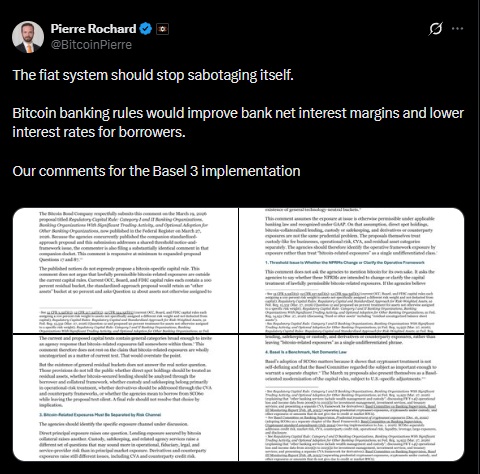
The gap would have some fairly concrete consequences. The Basel Committee already contemplates in its SCO60 framework a 1,250% risk weight for unbacked crypto assets such as Bitcoin. Rochard noted that regulators must clarify whether they will adopt that standard, apply it selectively, or fall back on existing domestic capital categories. Without that definition, banks are left to their own interpretation.
The Fiat System’s Self-Sabotage
Rochard argued that a final rule that imposes or preserves a capital treatment for Bitcoin-related activities without an explicit explanation could be legally vulnerable.
On March 5, the same agencies published a FAQ guidance on tokenized securities, declaring they should receive the same capital treatment as their non-tokenized equivalents and that the framework is “technologically neutral.” For Bitcoin, no comparable clarification exists.

Without clear rules, uncertainty spreads across the entire banking industry seeking to operate with Bitcoin. According to Rochard, the fiat system should stop sabotaging itself. Clear Bitcoin banking rules would improve net interest margins and reduce rates for borrowers.