TL;DR:
- ARK Invest and Unchained published a white paper estimating that 34.6% of the BTC supply remains exposed to quantum threats.
- Around 5 million BTC are considered migratable due to address reuse, and 1.7 million sit in P2PK addresses assumed to be lost.
- The first breach of a public key could occur in the mid-2030s, according to consensus established among Google, IBM, and Microsoft.
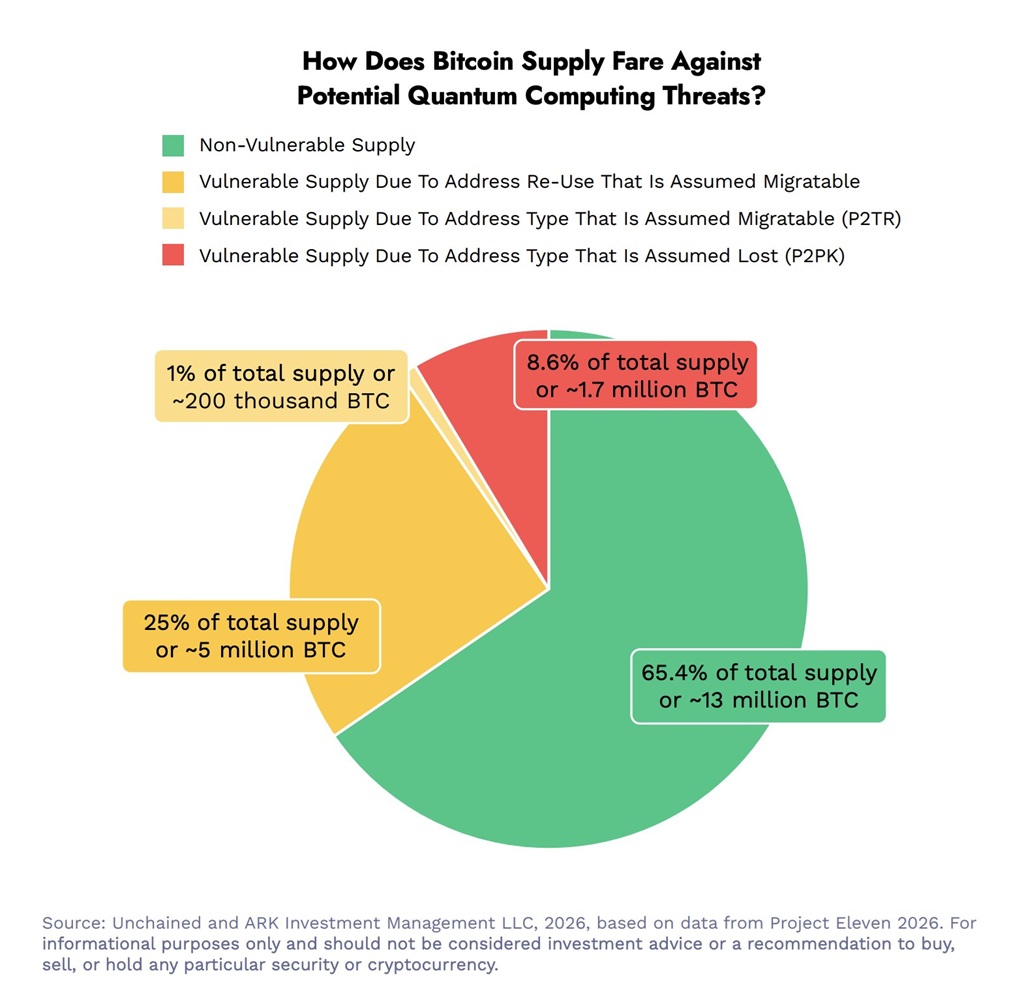
ARK Invest and Bitcoin-focused financial services firm Unchained published on Wednesday a joint white paper that analyzes in depth the exposure of Bitcoin’s supply to a potential breakthrough in quantum computing. According to the document, 65.4% of the BTC supply is no longer vulnerable to this type of threat, while the remaining 34.6% is still at risk should quantum computers advance enough to break elliptic curve cryptography (ECC).
The breakdown of the exposed supply includes approximately 5 million BTC, equivalent to 25% of the total, considered migratable due to address reuse. Added to that are 1.7 million BTC, or 8.6% of the supply, assumed to be lost in P2PK addresses, the oldest transaction format on the network, which tied funds directly to public keys. An additional 200,000 BTC, roughly 1%, are exposed through the P2TR or Pay To Taproot address type.
For a quantum computer to breach Bitcoin’s ECC, ARK estimates that approximately 2,330 logical qubits and tens of millions to billions of quantum gates would be required. The paper’s own authors acknowledge that reaching that level of performance “will take a very long time.”

ARK Sets a Countdown to 2030
ARK structures the advancement of quantum computing into five stages and argues that only the final one would allow ECC to be broken in less time than Bitcoin’s 10-minute block. The first breach of a public key could occur in the mid-2030s, in line with projections from companies such as Google, IBM, and Microsoft.
Meanwhile, Chicago-based firm PsiQuantum plans to complete by 2027 the first quantum computing installation with one million physical qubits, funded in part with capital linked to BlackRock.

The Possible Solutions
Faced with this outlook, ARK argues that Bitcoin will need to implement address formats secure against quantum attacks and, eventually, post-quantum cryptography (PQC). Among the alternatives mentioned are the lattice-based signature scheme ML-DSA and the hash-based scheme SLH-DSA.
The document also references draft BIP-360, which proposes a new output type designed to minimize quantum threats, though without incorporating post-quantum digital signatures. Chris Tam, president and head of quantum innovation at BTQ Technologies, warned that such signatures are “essential for any meaningful long-term defense against quantum attacks.”
The main challenge in implementing these solutions lies in Bitcoin’s decentralized governance, which requires majority consensus among network participants to approve any soft fork.