TL;DR
- Cactus Custody launched an institutional self-custody platform based on MPC that enables direct control of digital assets.
- Its system splits private keys into distributed, encrypted fragments, avoiding the risk of a single point of failure.
- The platform integrates compliance tools such as Chainalysis and Notabene and supports flexible AML and KYT options.
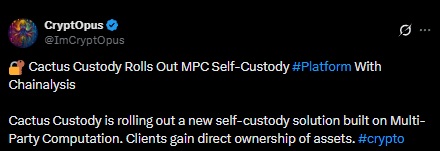
Cactus Custody launched a new institutional self-custody platform built on Multi-Party Computation (MPC), aimed at organizations that require direct control of digital assets without relying on centralized custodians.
The new product addresses growing demand for custody infrastructures that preserve fund ownership while integrating tools compatible with existing regulatory frameworks.
Cactus Splits and Encrypts Private Keys
The platform divides private keys into multiple encrypted fragments that are stored in a distributed manner, eliminating a single point of failure. This structure reduces the risk of key leakage and allows clients to retain operational authority over their assets. The design targets institutions that prioritize autonomy, operational continuity, and resilience in their custody infrastructure.
The system includes native integrations with compliance tools. These include onchain monitoring and transaction analysis solutions such as Chainalysis, as well as Travel Rule support through integration with Notabene. These capabilities allow clients to meet AML and KYT obligations and facilitate the exchange of information required by regulators for inter-entity transfers.

Operational Flexibility for All Institutional Profiles
Cactus Custody stated that its compliance integrations are flexible. Clients can choose to use Chainalysis for onchain analysis or request the integration of other providers, depending on their operational and regulatory needs. The approach aims to accommodate different institutional profiles without imposing a single technology stack.
In December, Cactus Custody announced a collaboration with an affiliate of Circle Internet Group to integrate USDC infrastructure. This integration allows institutional clients to manage USDC-related operational flows within the same custody system, streamlining processes and reducing external dependencies.
Cactus Custody CEO Daniel Lee said the product is designed for institutions that require self-custody solutions and prefer to avoid centralized custody models. The goal is to offer a platform that combines direct asset control, MPC-based cryptographic security, and compatibility with international regulatory requirements.
With this launch, Cactus Custody expands its offering toward a self-custody model that integrates security, compliance, and support for digital assets and stablecoins within an infrastructure built to operate at institutional scale