TL;DR
- Vitalik Buterin revisited his stance on full self-validation and stated that zk-SNARKs enable complete verification without reprocessing the entire chain.
- The disagreement with Ian Grigg centered on on-chain state storage, the use of state roots, and reliance on RPC services to access the current state.
- Ethereum has shifted toward zk-rollups such as zkSync, StarkNet, and Scroll. Buterin proposed removing legacy precompiles that limit zk proof generation.
Vitalik Buterin publicly revisited a position he had held since 2017 regarding full blockchain validation by users.
The Ethereum co-founder said he no longer agrees with a statement he made nearly a decade ago, when he dismissed full self-validation as a “weird mountain man fantasy.” His change in position is tied to the evolution of zero-knowledge cryptography, particularly zk-SNARKs.
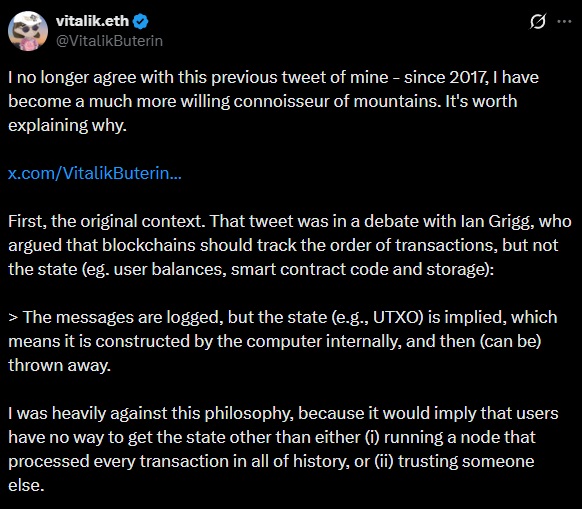
In 2017, Buterin was engaged in a technical dispute with theorist Ian Grigg over blockchain design. Grigg argued that blockchains should only record transaction ordering, while the full state should be reconstructed locally and discarded. Buterin opposed that approach because it required re-executing the entire transaction history or relying on third-party RPC services to obtain the current state.
Why Did Buterin Change His Mind?
At the time, Buterin defended a model in which the full state is stored on-chain and anchored to block headers via state roots. Under that design, users could verify specific values using Merkle proofs, assuming an honest majority under proof-of-work or proof-of-stake. Full validation by every user was computationally unfeasible without severely constraining network capacity.

The central shift highlighted by Buterin is the maturation of zk-SNARKs. These cryptographic proofs allow a set of computations to be proven correct without re-running them or revealing the underlying data. That advancement removed the need to reprocess the entire chain history to verify its validity.
According to Buterin, zk-SNARKs make it possible to achieve full verification guarantees without imposing prohibitive costs on users. This development enables a reassessment of earlier trade-offs related to scalability, decentralization, and verification within Ethereum. The new approach also addresses operational scenarios involving service outages, latency spikes, infrastructure shutdowns, or external pressure on intermediaries.

Ethereum’s New Roadmap
Buterin revived the “mountain man’s cabin” metaphor as a fallback mechanism that allows direct interaction with the network when other layers fail. This vision aligns with the growing prominence of zk-SNARKs in Ethereum’s roadmap.
The network now shows a clear focus on zk-rollups as a scaling solution. These layer-two networks bundle thousands of transactions and submit a single cryptographic proof to Ethereum. Projects such as zkSync, StarkNet, and Scroll already operate under this model, each with different technical trade-offs.
Vitalik also identified legacy components that limit the full adoption of zero-knowledge systems. In 2025, he proposed removing the modular exponentiation precompile, which had become a bottleneck for zk proof generation