TL;DR
- Ethereum maintains an accumulation regime based on the realized cost of long-term holders, which has risen steadily since 2020 and is now concentrated between $2,700 and $2,800.
- During the 2022–2023 correction and the stress episodes of 2025, ETH’s accumulation cost remained stable, unlike altcoins that lack a solid buying base.
- Over the past 24 hours, Ethereum recorded $42 million in liquidations and absorption flows near the accumulation cost, which continues to act as a structural reference.
Ethereum maintains an accumulation regime defined by the realized cost of addresses that consistently buy ETH and do not operate on a short-term basis. This metric tracks the average price at which these holders build their positions and serves as a structural reference within the market.
Since 2020, Ethereum’s accumulation cost has followed an upward trajectory. Even during the 2022–2023 correction, when the spot price fell sharply, the realized cost of accumulation addresses remained stable. This behavior was recorded again during subsequent stress episodes, including those in 2025, without abrupt changes in the cost base.
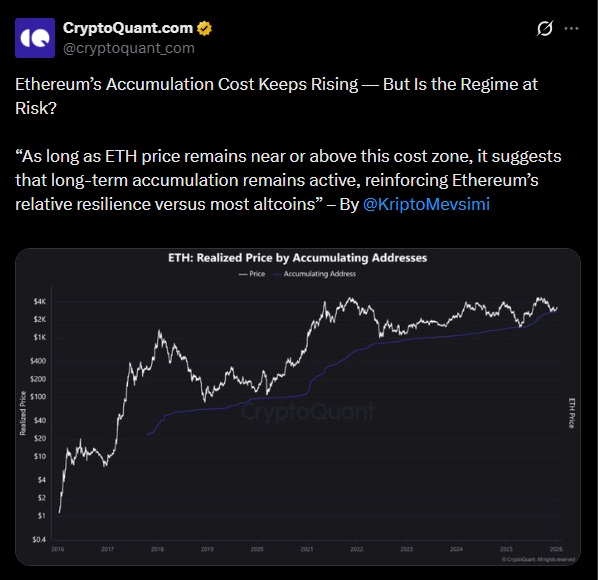
Long-Term Holders Continue Accumulating Ethereum
At present, the accumulation cost sits in the $2,700–$2,800 range. This level concentrates recurring purchases and defines a structural zone where long-term addresses continue adding Ethereum. Across multiple volatility events, price action found demand in this range, without sustained breaks below it.
This contrasts with the broader altcoin market. Since 2022, many alternative assets have failed to develop a comparable accumulation base. Declines occurred without consistent absorption by long-term holders, resulting in deeper drawdowns and limited recoveries. Ethereum, by contrast, maintained an active cost structure throughout the cycle.
The Key Difference Versus Altcoins
Recent market activity has reinforced this pattern. Over the past 24 hours, Ethereum recorded liquidations of approximately $42 million, with $26.5 million tied to long positions. Liquidations of short positions, meanwhile, reached $16 million. Subsequent flows showed absorption in areas close to the accumulation cost.
CryptoQuant data indicates that gradually accumulating addresses continue to concentrate ETH in the $2,700–$2,800 range. In late 2025 and early 2026, these addresses added millions of ETH despite market pressure. Trend Research places the average accumulation cost at a higher level, around $3,150, expanding the price range where long-term positions were formed.

ETH Remains in a Sideways Range
From a structural standpoint, the current regime holds as long as price trades around or above the accumulation cost. A sustained break below that base would imply a shift in long-term holder behavior, as the realized cost would cease to function as an active buying zone.
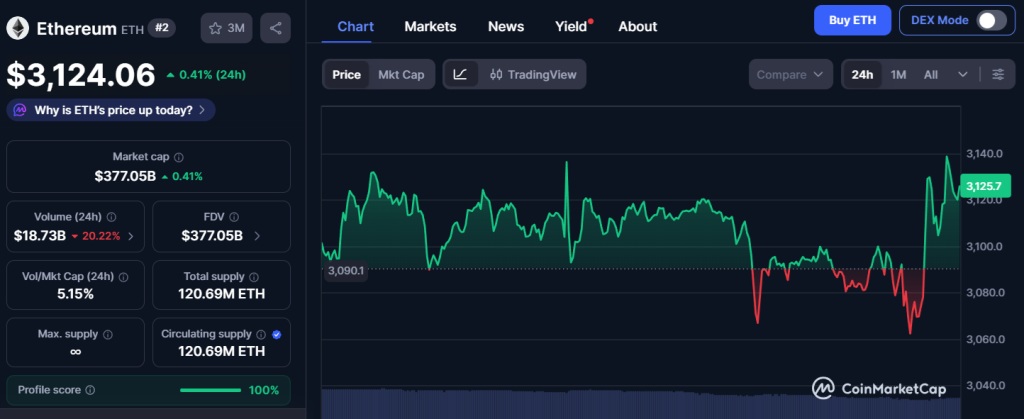
In the short term, Ethereum continues to trade within a sideways range and has returned to the December trading area, with price hovering around $3,100. Technical resistance is concentrated near $3,300, while the $2,900 area aligns with prior support levels within the current channel