TL;DR:
- The BEAT token recorded an increase of over 65% in its price during the last 24 hours, reaching an approximate value of $4.37.
- NEAR Protocol accumulated a daily gain of nearly 13%, successfully reclaiming the technical support level located in the $2.01 range.
- The DEXE cryptocurrency accumulated a 16% rally over the past week, hovering around $22.82 despite a decline in its trading volume.
At the beginning of the second week of June, BEAT, NEAR, and DEXE stand out as the 3 altcoins gaining attention within the digital asset market. The trio is trading above their previous price ranges. However, technical analysts assert that the loss of trading volume on certain charts and overbought momentum readings raise doubts about the sustainability of this bullish trend in the short term.
Technical Formations and Market Milestones in the Crypto Ecosystem
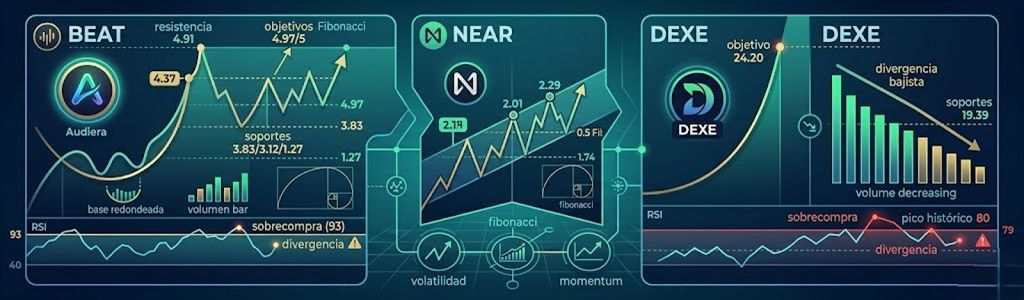
Audiera’s native token, BEAT, is trading around $4.37, ranking 61st in the global market capitalization standings with a valuation of $1.26 billion. The daily chart reveals that the asset completed a rounded base simulating a cup-and-handle structure before breaking out to the upside in late May 2026. Following this move, the price chained three consecutive green candles of large magnitude.
Chart analysis seems to indicate that the value is approaching its previous all-time high of $4.91. Clearing this barrier could open the door to a technical projection toward the Fibonacci target of $4.97, very close to the psychological threshold of 5 units. This technical evolution was supported by two notable spikes in traded volume, detected at the end of last month and during the most recent sessions. On the other hand, the daily Relative Strength Index (RSI) entered deep overbought levels near 93 points, although the current reading does not yet show obvious bearish divergences.
In the event of a market correction, the first identifiable support zone is located at $3.83, corresponding to the previous high. Deeper bearish projections suggest that the Fibonacci retracement levels of 0.618 and 0.236 could act as secondary containments at $3.12 and $1.27, respectively.
Meanwhile, at the beginning of this week, NEAR Protocol trades near $2.15. Its capitalization is estimated at $2.79 billion, placing the token at number 36 in the global ranking. After starting an upward pattern in February, the price broke through resistance at $1.40 in mid-May. Later, the price advanced to the $2.80 zone, where selling pressure rejected the quotation on two occasions.
NEAR experienced a retracement toward the support of the 0.382 Fibonacci level located at $1.74, successfully bouncing from there. By recovering the 0.5 retracement point at $2.01, data suggests that buying activity remains firm. Current projection models indicate that if the $1.74 support holds, the next technical target is set at $2.29 before seeking a third verification of the key resistance at $2.80.
DEXE’s Behavior Under Low Volume Conditions
DeXe trades around $22.82, maintaining an approximate market capitalization of $1.07 billion, ranking 66th in the digital markets. The weekly timeframe chart shows that the asset has risen steadily from its annual lows of $2 recorded at the beginning of 2026, drawing a parabolic trajectory.
In recent sessions, the price tested the technical target set at $24, coinciding with the 1.0 Fibonacci level at $24.20, registering a local high of $23.26. Nevertheless, market readings reveal that traded volume progressively decreased during the advance, a factor that does not fully validate the strength of the bullish move. Additionally, the weekly RSI stands at 79 points, an area very close to its historical peak of 80. The coincidence of these technical factors could lead to an initial bearish divergence, which would trigger a correction phase toward the support at $19.39.
The development of the upcoming trading sessions will definitively determine whether DEXE manages to solidly pierce the $24 resistance to extend its bullish structure or if, on the contrary, it faces a rejection that forces it to test lower support levels.