The tokenization of financial assets has entered a new phase in Brazil. CSD BR, a regulated financial infrastructure provider in the Brazilian market, has begun mirroring records of BTG Pactual investment fund holdings on the XRP Ledger (XRPL) through a partnership with Ripple announced on September 29, 2026. The project uses a public blockchain as a complementary layer for recording, verifying, and auditing information, while CSD BR retains the official record of ownership, custody, and settlement.
The development was analyzed extensively by YouTuber Crypto Sensei, who presented the initiative as one of the most significant institutional developments involving the XRP Ledger. His analysis focuses on the importance of integrating a public blockchain into regulated financial infrastructure, particularly because the deployment involves records associated with real-world operations rather than only simulated test assets.
CSD BR is authorized by Brazil’s Central Bank to provide registration, deposit, and settlement services, and it also holds authorization from the Comissão de Valores Mobiliários (CVM) for certain registration and deposit activities. The company reports having more than 22 trillion Brazilian reais in registered assets, a figure equivalent to roughly $4 trillion depending on the exchange rate used. However, this amount represents the total volume handled by the infrastructure and does not mean that $4 trillion worth of assets are being transferred to or tokenized on the XRP Ledger.
XRP Ledger As An Institutional Verification Layer
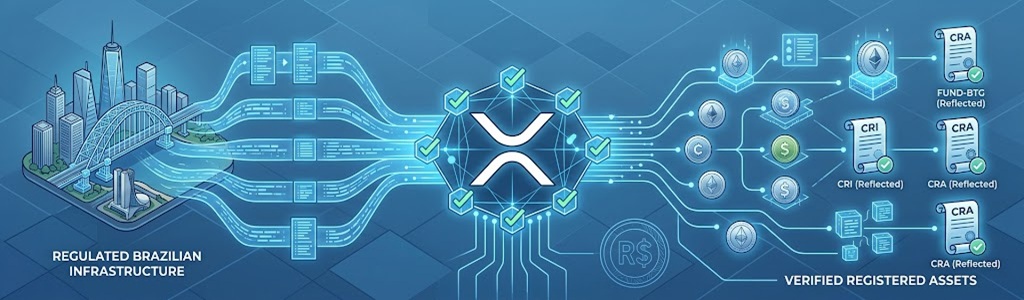
The structure of the project is particularly relevant because CSD BR is not replacing its traditional infrastructure with blockchain. The BTG Pactual fund holdings remain under CSD BR’s official records, while their digital representations are mirrored on XRPL. Authorized institutions can therefore consult the information recorded on the blockchain and compare it with official records in close to real time.
This architecture addresses one of the recurring challenges in financial markets: reconciliation between records. Banks, custodians, and other participants maintain their own systems and must periodically verify that their information matches the data held by the central securities infrastructure. A verifiable copy on a public blockchain could facilitate the identification of discrepancies and reduce part of the reconciliation process, while CSD BR continues to retain legal authority over the underlying assets.
The holdings are represented using the Multi-Purpose Token (MPT) standard on the XRP Ledger. The architecture also includes controls designed for regulated financial assets, including restrictions on participants and mechanisms that can allow assets to be frozen or transactions reversed when required by a judicial or regulatory order. Authorized participants remain subject to know-your-customer and anti-money-laundering controls.
Daniel Polano Spreafico, Head of Products and Clients at CSD BR, explained that the company chose to begin with mirroring because it provides a gradual way to introduce new technology into critical financial infrastructure. The model allows blockchain technology to be tested without initially changing the existing legal and operational framework, while traditional systems remain the official reference.

From BTG Pactual Funds To New Asset Classes
The project is also significant because of what could follow this initial stage. Ripple and CSD BR plan to progressively move toward native asset issuance and eventually trading between authorized participants directly through blockchain infrastructure. Future stages are expected to include Real Estate Receivables Certificates (CRI) and Agribusiness Receivables Certificates (CRA), both important instruments within Brazil’s fixed-income market.
Crypto Sensei has also highlighted the potential economic scale that could eventually be represented on XRPL. Estimates associated with the project point to approximately $15 billion in represented market value during an initial expansion. This figure requires an important clarification: it does not represent $15 billion worth of XRP purchases, nor does it mean that this amount of capital will flow directly into XRP. Instead, it refers to the value of financial assets that could potentially be represented digitally through the infrastructure.
That distinction is essential when assessing the economic implications of the announcement. Institutional adoption of XRPL does not necessarily require every tokenized asset to generate an equivalent purchase of XRP, but it does increase the potential role of the network as infrastructure for recording, verifying, issuing, and potentially trading financial assets.
A Real-World Test For Blockchain Infrastructure
The Brazilian case therefore differs from traditional tokenization experiments based exclusively on simulated assets or private networks. CSD BR is using a public blockchain within a regulated environment while maintaining its traditional infrastructure as the official source of ownership records. This creates a hybrid architecture that allows the technology to be evaluated without immediately transferring legal responsibility for the underlying assets to the blockchain.
The next stage will be particularly important. If the mirroring system performs successfully, the ability to issue and trade assets directly through XRPL could significantly expand the network’s role within Brazil’s capital markets. The potential addition of CRI and CRA would also provide an opportunity to test how the infrastructure handles different classes of financial instruments.
Final Reflection
The most significant aspect of this development is not that 22 trillion reais worth of assets have moved onto the XRP Ledger, because that has not happened. The importance lies somewhere more specific: a regulated financial infrastructure is using a public blockchain to represent and verify real records while maintaining the existing legal framework. If subsequent stages move forward, Brazil could become an important real-world testing ground for how tokenization can progressively integrate with traditional financial markets.
Disclaimer: This article has been written for informational purposes only. It should not be taken as investment advice under any circumstances. Before making any investment in the crypto market, do your own research.