XRP occupies a distinct position in the digital asset ecosystem. Its monetary argument does not rest on being a decentralized store of value like Bitcoin, nor on being a fiat-pegged settlement instrument like a stablecoin. Instead, XRP is designed as neutral, counterparty-free bridge money native to the XRP Ledger (XRPL)—an asset whose utility is structurally embedded in the network’s operation and its growing role in institutional finance.
The Monetary Case: Native, Neutral, and Counterparty-Free
The core of XRP’s monetary identity is its technical status as the only native asset on the XRP Ledger. Unlike tokens issued on the ledger, XRP requires no issuer, no trust line, and carries no counterparty risk. This makes it a uniquely neutral settlement asset: no entity can freeze it, and any participant on the network can accept it without needing to evaluate a third-party issuer.
This design creates a direct, structural link between network activity and demand for XRP. Every transaction on the XRPL requires a small fee paid in XRP, and every account must maintain a minimum XRP reserve. These requirements mean that as the ledger is used—for payments, tokenized asset trading, or institutional settlement—XRP is necessarily consumed.
A portion of each transaction fee is permanently destroyed (burned), introducing a mild deflationary pressure on the fixed supply of 100 billion XRP. As of late 2026, approximately 14.4 million XRP had been burned since the network’s launch.
Real-World Utility: The Bridge Asset for Institutional Finance
XRP’s monetary role extends beyond fee payment. Within the XRPL’s built-in decentralized exchange (DEX), XRP functions as the auto-bridging asset. When a direct trading pair between two issued assets lacks liquidity, the protocol can automatically route the trade through XRP (Asset A → XRP → Asset B) to achieve a better execution rate.
This utility is increasingly being channeled into institutional use cases. Ripple’s On-Demand Liquidity (ODL) service uses XRP as a bridge currency to facilitate cross-border payments without pre-funding destination accounts. As of early 2026, RippleNet connected over 300 financial institutions across 55+ countries, with roughly 40% using ODL/XRP in practice.
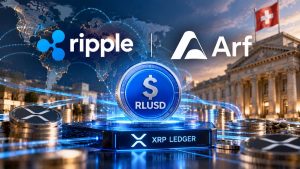
More recently, the ecosystem has expanded to include RLUSD, a regulated dollar stablecoin issued on the XRPL. Partnerships, such as the one with Swiss firm Arf to bring $10 billion in annual settlement volume to the ledger, illustrate a complementary model: RLUSD provides the stable settlement instrument, while XRP serves as the underlying asset for network fees and reserves that make those transactions possible.
Competitive Positioning: XRP vs. Bitcoin and Stablecoins
XRP’s monetary characteristics distinguish it from the two dominant models in crypto.
Against Bitcoin: Bitcoin’s primary monetary value proposition is sovereign scarcity—a fixed-supply asset secured by proof-of-work, independent of any company or state. XRP competes on a different axis: settlement efficiency and network utility.

Ripple’s CTO Emeritus, David Schwartz, has argued that for long-duration escrow or locked funds, assets like XRP or BTC may be preferable to stablecoins due to upside potential, but XRP’s specific advantage lies in its role as the efficient, neutral medium of exchange within a financial network. Data supports this functional difference: the average XRP transaction size has been significantly larger than Bitcoin’s, suggesting usage skewed toward larger-value transfers.
Against Stablecoins: Stablecoins like USDC or RLUSD are designed to be fiat-denominated settlement instruments, offering price stability but reintroducing issuer and regulatory counterparty risk. XRP offers neutrality and censorship resistance that a fiat-backed token cannot, but it does not offer price stability.
The two are increasingly complementary on the XRPL: stablecoins serve as the value instrument for payments, while XRP serves as the neutral, native asset that secures the network and bridges liquidity between different tokenized assets.
Regulatory Clarity: A Settled Legal Position
XRP’s legal status in the United States has become unusually clear for a major digital asset. A 2023 federal court ruling established that XRP is not a security when sold on public exchanges. This was reinforced in March 2026, when the SEC and CFTC issued a joint interpretation formally naming XRP a digital commodity.
While the broader market-structure bill (the CLARITY Act) failed to advance in the Senate in September 2026, Ripple’s leadership has emphasized that this does not alter XRP’s established clarity. The company has also secured conditional approval from the Office of the Comptroller of the Currency (OCC) for a national trust bank charter, providing an alternative path to federal legitimacy even without new legislation. This regulatory footing is a meaningful competitive advantage compared to assets still facing classification uncertainty.
Market Signals and Institutional Flows
Market data in late 2026 reflects the tension between XRP’s developing utility and its price dynamics. Spot XRP ETFs have seen cumulative net inflows of approximately $41 million since the start of 2026, with notable daily inflows from firms like Franklin Templeton.
However, this institutional demand has coexisted with selling pressure from large holders (“whales”), keeping the price testing support in the $1.28–$1.30 range. The number of non-empty wallets on the XRPL has reached a record high, indicating growing network participation even amid price consolidation.
XRP’s unique place in the digital asset ecosystem is defined by its role as neutral, native money for a financial network. Its monetary value is not primarily speculative or fiat-referenced; it is derived from being the indispensable asset for fee payment, reserve maintenance, and liquidity bridging on a ledger that is actively building institutional-grade infrastructure for payments, tokenization, and DeFi.
Its regulatory clarity and growing—if still evolving—integration with real-world financial flows give it a distinct profile among major digital assets. The long-term thesis, as articulated by its architects, is straightforward: if the XRPL succeeds as a venue for moving and holding value, XRP is structurally positioned to capture a portion of that value because of its unique advantages on the network.