The Senate failure of the CLARITY Act is not a minor regulatory gap. It is a political decision with measurable effects on digital asset market structure. The bill sought federal authority for stablecoins, spot market, custody, and intermediary registration.
Without federal law, crypto regulation in the United States remains fragmented among agencies, states, and courts. The immediate result is an advantage for traditional banks, which avoid direct competition for their deposit base, and for jurisdictions with defined operating frameworks, with Dubai and the United Arab Emirates as a relevant case.
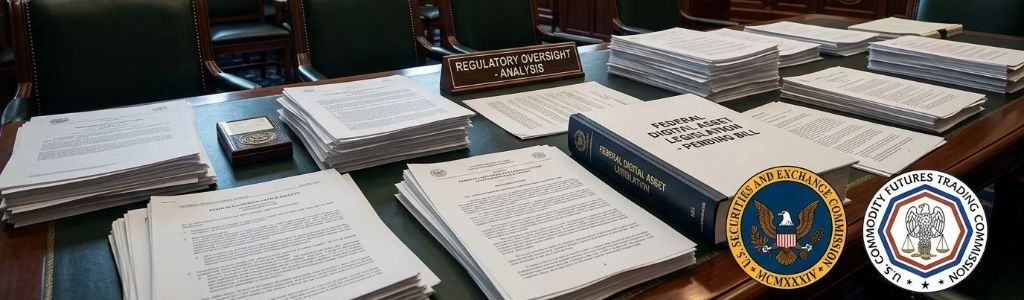
The CLARITY Act intended to resolve a long-standing dispute: who regulates what. The SEC and the CFTC hold different positions on the nature of tokens. Lack of definitions produces compliance costs, litigation, and restrictions for exchanges, custodians, and issuers.

A federal framework would have allowed stablecoins to operate under uniform rules, including reserves, audit, redemption, and possible remuneration. The crypto industry expected clarity to facilitate institutional adoption.
Traditional banking expected something else: the law would not enable products capable of competing with bank deposits. The Senate failure maintains the status quo.
The main reason banks benefit is competition for deposits
A federally regulated stablecoin, with high-quality reserves and guaranteed redemption, can function as a dollar transaction account. If the instrument offers yield, the incentive to move balances from a bank account to a digital product is direct.
Banks fund part of their balance sheet with low-cost deposits. Migration raises the cost of funds and pressures the net interest margin. The law would have created a path for nonbank issuers to compete in the payments and treasury segment. The legislative block avoids competition during the next cycle.

Banks are not opposed to technology. Several explore deposit tokenization, institutional custody, blockchain settlement, and cross-border payments. The difference is the framework.
Banks prefer to develop digital products inside their license, with deposit insurance, discount window access, and prudential regulation. A stablecoin issuer with a federal license could operate outside the structure. The CLARITY Act failure delays symmetric competition. Banks gain time to integrate blockchain without ceding retail deposit share.
For Dubai and the UAE, legislative paralysis in Washington reinforces a comparative advantage. The country has VARA in Dubai, ADGM in Abu Dhabi, and DIFC as financial centers with specific rules for virtual assets. The frameworks cover licensing, capital, custody, market conduct, and anti-money laundering.
The UAE hosts more than 110 regulated virtual asset businesses, with additional applications in process. Operational clarity attracts founders, funds, and companies facing uncertainty in the United States.
The CLARITY Act failure produces a legitimate regulatory arbitrage effect. Companies do not seek to evade supervision; companies seek enforceable rules. An exchange or stablecoin issuer can establish operations in Dubai with a defined license, audit requirements, and access to correspondent banking.
The UAE does not depend on a United States federal law to authorize custody or payments with digital assets. Each year of debate in Washington allows Dubai to consolidate talent, capital, and operating volume.
The crypto sector should interpret the outcome as a resource allocation signal. The strategy of waiting for federal law in the United States carries opportunity costs. Compliance, legal, and operations teams can deploy in jurisdictions with defined regulatory frameworks.
Dubai is not the only option: Singapore, Switzerland, Hong Kong, and the United Kingdom compete for the same flow. The difference is the UAE combination of regulation, banking infrastructure, and connectivity with markets in Asia, Africa, and Europe.
Lack of federal stablecoins keeps banks as main intermediaries in payments and deposits. Banks can offer custody to institutional clients and charge for settlement and treasury. Convergence between banking and crypto occurs, but under bank controls. The CLARITY Act would have accelerated a more open model. The Senate failure preserves a more closed model.
Compliance requirements are strict. Companies must comply with FATF, sanctions, and beneficial ownership reporting. VARA and ADGM supervision requires minimum capital, corporate governance, and audits. Not every crypto company qualifies.
The UAE also does not offer direct access to the United States deposit system. Stablecoin issuers face restrictions to serve United States clients without federal and state compliance. The advantage is relative, not absolute.
United States banking also faces limits
bsence of federal law does not eliminate competitive pressure from stablecoins issued abroad. A user can hold USDC or USDT on an offshore exchange. Cross-border payments with stablecoins already occur outside the banking perimeter.
Lack of CLARITY Act does not stop demand for digital dollars. The dynamic displaces infrastructure and regulatory risk toward other jurisdictions.
In my view, the crypto sector should not celebrate the CLARITY Act failure. The law was not perfect. The text included compromises on stablecoins, market structure, and registration. A federal framework was preferable to the current ambiguity.
The legislative failure benefits banks because it protects the deposit base and delays competition from nonbank issuers. The failure benefits Dubai because it offers an operating alternative to companies and funds needing regulatory clarity. The cost is borne by the United States market: talent, capital, and volume migrate to jurisdictions with defined rules.
The conclusion for founders, exchanges, and issuers is direct. Regulatory strategy must be multijurisdictional. A license in the UAE, Singapore, or Switzerland does not replace United States compliance, but reduces dependence on a single jurisdiction. Institutional expansion of digital assets occurs where rules, correspondent banks, and supervision exist. Regulatory clarity is a competitive asset. Washington has not delivered. Dubai and banks capture the benefit.
Operationally, the CLARITY Act would have defined treatment of stablecoins as payment instruments and not as securities. The distinction would have allowed issuers to operate with greater certainty, but also opened the door to explicit yields.
Banks have argued a payment product with yield competes directly with savings accounts and money market funds. The Senate failure avoids discussion at the federal level. States can regulate, but lack of uniformity limits the scale of nonbank issuers.
The impact on tokenization of real-world assets is similar
Banks can tokenize deposits, bonds, and funds within prudential frameworks. Independent issuers need licenses and approvals varying by jurisdiction. Dubai offers a single path for tokenized funds, real estate, and commodities.
The UAE attracts asset managers seeking custody and settlement structures with known rules. Absence of federal law in the United States does not eliminate institutional interest; the absence redirects interest.
The reading for Dubai is consolidation
The reading for the crypto sector is strategic urgency. Regulatory clarity will not arrive soon from Washington. Companies must build multijurisdictional compliance, diversify licenses, and operate where rules are enforceable. Institutional adoption does not wait for a single legislator. Infrastructure is built in jurisdictions with regulatory frameworks. The CLARITY Act failure benefits banks and Dubai. The rest of the sector must adapt strategy to the reality.
By blocking the law, banks preserved operating advantages, delayed regulations favorable to Bitcoin, and maintained the marginalization of crypto investments within the traditional financial perimeter, where innovation remains subordinate to banking licenses, prudential capital, and existing supervision.
Crypto Economy, views the prohibition of the CLARITY Act for the benefit of banks unfavorably, because the outcome consolidates a status quo that limits competition, regulatory clarity, and crypto infrastructure development in the United States.