TL;DR
- Custodia Bank asked the full Tenth Circuit to review the Fed’s refusal to grant a master account, escalating a legal dispute that has already lasted five years.
- The bank argues that the Fed is exercising unreviewable discretion that contradicts the Monetary Control Act and grants an unconstitutional veto over state banking licenses.
- OCC scrutiny of debanking practices targeting crypto companies has intensified.
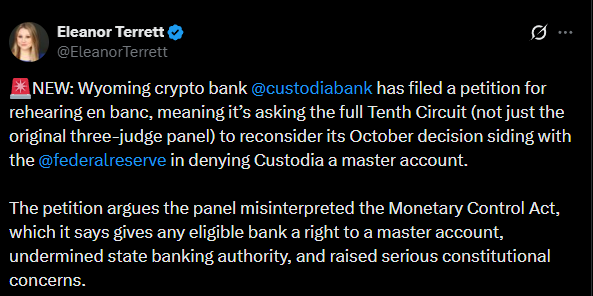
Custodia Bank, a Wyoming-chartered crypto bank, filed a petition asking the full Tenth Circuit Court of Appeals to review the Federal Reserve’s decision to deny it access to a master account. The legal battle has been ongoing for five years and challenges a ruling by a three-judge panel that upheld the central bank’s denial.
The petition, filed on December 15, seeks an en banc review so that all active circuit judges can assess whether regional Federal Reserve Banks can exercise unreviewable discretion to grant or deny master accounts to institutions that meet legal eligibility requirements. Custodia argues that this interpretation conflicts with the Monetary Control Act, which states that payment services “shall be available” to nonmember depository institutions.
Crypto Banks Face Regulatory Bias
The bank contends that the decision grants the Fed an unconstitutional veto power over state-chartered banks. Wyoming authorized Custodia in 2020 as a Special Purpose Depository Institution (SPDI), a framework designed to attract digital asset companies, requiring 100% reserve backing and prohibiting lending to limit risk. Without access to a master account, Custodia cannot use basic services such as wire transfers or ACH payments, rendering its state-issued license effectively meaningless.
The filing also raises additional constitutional objections. Custodia argues that if presidents of regional Federal Reserve Banks hold absolute discretion to deny accounts, they are exercising executive authority without being appointed in accordance with the Appointments Clause. These officials are selected by private bank directors and approved by the Board of Governors, a process the bank says is incompatible with that level of authority.

Custodia Continues to Appeal Court Decisions
The case highlights a split within the Tenth Circuit itself. The dissenting opinion by Judge Timothy Tymkovich aligned with a prior 2017 ruling, creating a 2-2 divide among circuit judges on whether the law requires granting master accounts. Tymkovich warned that the Fed’s interpretation contradicts the plain text of the statute and raises concerns under Article II of the Constitution.
The Federal Reserve Bank of Kansas City formally rejected Custodia’s application in January 2023 after a 27-month review, citing risks tied to crypto-related activities. Internal documents showed that staff had deemed the bank’s capital adequate and viewed its management team favorably before the Board of Governors intervened.
The dispute unfolds amid heightened scrutiny of debanking practices. In December, the OCC concluded that the nine largest national banks imposed inappropriate restrictions on lawful businesses, including crypto companies, between 2020 and 2023