TL;DR
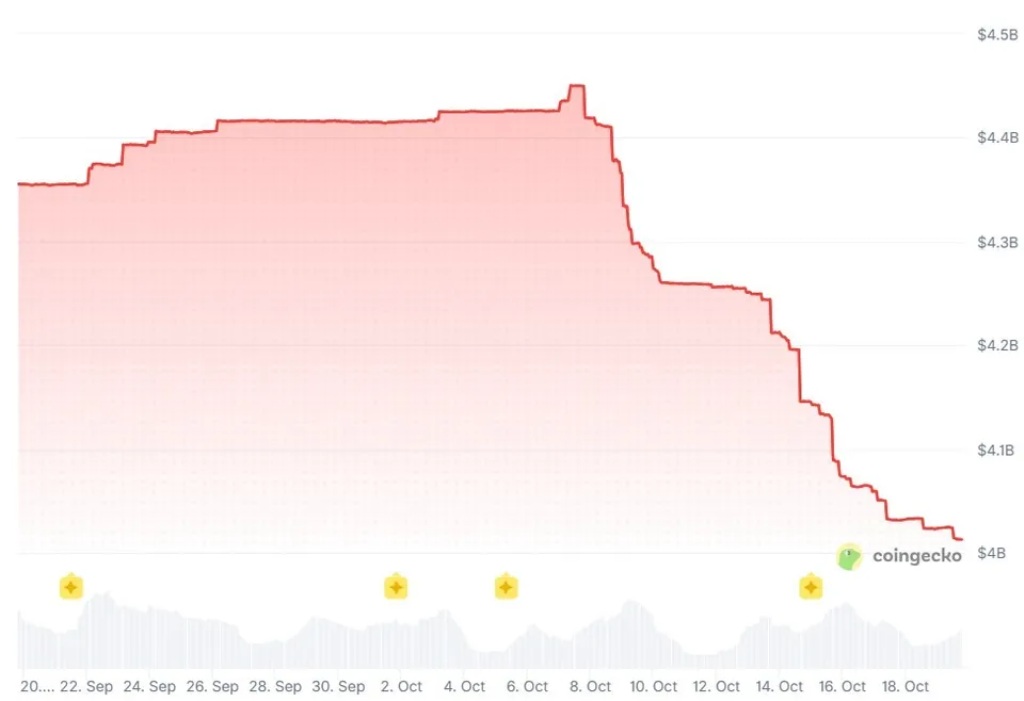
- USD1’s market capitalization fell from $4.43 billion to $4.02 billion in two weeks, a decline of approximately 9.1%.
- Ethereum and BNB Chain recorded around $385 million in redemptions. A single unidentified address redeemed nearly $200 million on BNB Chain.
- The stablecoin maintained its dollar peg throughout the period analyzed, despite the reduction in its circulating supply.
World Liberty Financial’s USD1 stablecoin lost approximately $400 million in market capitalization over the past two weeks, following a series of large redemptions primarily on Ethereum and BNB Chain.
According to CoinGecko data, its market capitalization fell from $4.43 billion on October 6 to approximately $4.02 billion, a decline of around 9.1%. Meanwhile, World Liberty Financial’s proof-of-reserves dashboard reported approximately $4.01 billion in backing assets.
The decline was associated with the burning of tokens submitted for redemption by their holders. However, USD1 maintained its dollar peg throughout the period examined by blockchain analytics firm Onchain Benchmark, trading between $0.998 and $1.
The records analyzed showed no sustained loss of the dollar peg, meaning the decline in market capitalization was primarily driven by a reduction in circulating supply rather than a substantial depreciation of the stablecoin.
Ethereum and BNB Chain Record Hundreds of Millions in Redemptions
Between October 6 and October 15, Ethereum recorded $184.60 million in net redemptions, spread across 63 token burns, according to Onchain Benchmark.
On BNB Chain, redemptions reached $200.43 million across 12 transactions. Nearly $200 million came from a single address whose owner could not be identified.
Funds from that address were redeemed in batches of between $30 million and $50 million. The analytics firm was also unable to determine who controlled the wallet or why the redemptions took place.
On Ethereum, more than 99% of the tokens submitted for redemption passed through an address identified as belonging to BitGo, USD1’s current issuer and custodian.
Transfers between Ethereum and BNB Chain totaled less than $1 million during the period studied. The records therefore do not support the idea that the supply reduction on both networks was simply the result of tokens being moved between them.
USD1 Records a Steeper Supply Decline Than USDT and USDC
USD1’s supply contraction on Ethereum was more pronounced than that of other dollar-pegged stablecoins during the same period.
Between October 6 and October 15, its supply on Ethereum fell 11.45%, compared with declines of 4.93% for USDe, 2.18% for USDC, and 0.76% for USDT.
On Solana, however, supply remained virtually unchanged at approximately $1.42 billion during the nine days examined by Onchain Benchmark. There was insufficient new issuance on that network to offset the redemptions recorded on Ethereum and BNB Chain.
The firm also warned about USD1’s dependence on a small number of large holders, whose decisions can cause substantial changes in its circulating supply.
The analysis also addressed the stablecoin’s upcoming change of issuer, linked to the establishment of a World Liberty Financial trust company. The entity would take over USD1 issuance under a regulatory charter whose legal standing, according to Onchain Benchmark, is being challenged in court.
The remaining question is whether new issuance will restore the supply withdrawn during October and how much USD1 will be in circulation when the issuer transition takes place.