TL;DR
- Bitcoin whales cut their positions by 36,500 BTC since December, an orderly distribution equivalent to $3.37 billion.
- Bitcoin traded between $85,000 and $94,000. Whale selling pressure increased by more than 130% over the month.
- ETF demand failed to absorb the supply, sharks are accumulating, and the focus has shifted to exchanges.
Bitcoin whales shook the crypto market once again. On-chain data confirms that wallets holding between 10,000 and 100,000 BTC reduced their positions by 36,500 BTC since the start of December. At current prices, that distribution amounts to roughly $3.37 billion. This is not a marginal adjustment. It is an orderly exit by one of the most influential segments of the market.
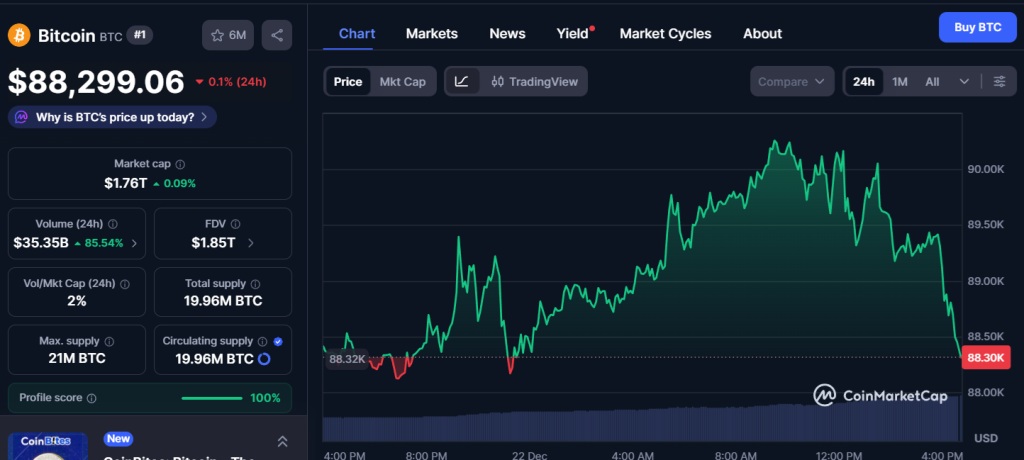
This shift must be viewed within a backdrop of persistent volatility and a lack of clear direction. Throughout December, BTC traded within a wide range, between $85,000 and $94,000, failing to sustain upside breakouts. At the time of writing, BTC trades just below $88,300. The inability to hold higher levels coincides with a sharp increase in selling pressure from these whales, which rose by more than 130% during the first half of the month
Whales Pull Back While Sharks Accumulate
This behavior does not reflect retail profit-taking or impulsive reactions. Whales typically act with planning and long-term objectives. When this group reduces exposure, the market often enters periods of extended consolidation or deeper corrections. It is not a mechanical rule, but it is a pattern that warrants close monitoring.
The reduction in these positions carries additional weight because it occurs despite the presence of some favorable institutional signals. In recent weeks, spot Bitcoin ETF inflows have picked up. However, that incoming demand proved insufficient to absorb the supply released by large holders. The outcome is a market that maintains volume but lacks upward momentum.
At the same time, an opposite dynamic is emerging in lower tiers. Wallets holding between 100 and 1,000 BTC, known as sharks, are showing signs of accumulation. This divergence points to an internal rotation process within the market.

Where the BTC Goes Will Be the Key
Attention is now focused on flows into exchanges. If the distributed BTC begins moving steadily into centralized platforms, it would confirm intent to sell on the open market. That scenario would increase the likelihood of a move toward lower support levels, with a key technical zone around $80,400. If, instead, the BTC remains off exchanges, the market could continue to trade sideways while it absorbs the redistribution.