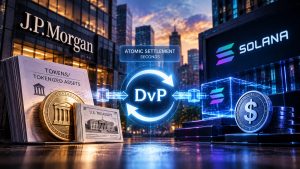
Yesterday, the Depository Trust and Clearing Corporation (yes, that massive, quiet entity that sits behind the scenes safeguarding $114 trillion in assets) wrapped up a massive live test. This involved genuine, live production assets. Over 30 institutional giants, including BlackRock, JPMorgan, Vanguard, and Goldman Sachs, spent the day spinning up digital representations of actual Microsoft shares, Circle internet group stock, short-term Treasury bills, and major index funds like the QQQ.
What you end up with is an infrastructure shift that forces the entire crypto landscape to grow up, fast. The day-long run proved that blockchain rails could comfortably handle the heavy lifting of day-to-day corporate operations, spanning multiple complex financial workflows including collateral pledges (processed instantly to reduce capital lockup), securities lending executed without waiting for manual ledger updates, treasury repo agreements settled on a delivery-versus-payment basis, and equity trades cleared directly across distributed nodes.
“Today is the beginning of a long journey where we will demonstrate that the old and the new can live together.” — Nadine Chakar, Global Head of DTCC Digital Assets
The Mechanics of the “Digital Twin”
The DTCC minted tokenized entitlements directly onto Hyperledger Besu – their private enterprise network – and Canton, which is a public blockchain designed specifically for regulated finance. This is where the Webopedia team’s deep dive into tokenized stock mechanics becomes highly relevant; these digital representations aren’t just synthetic trackers that mimic price from a distance. They are direct, on-chain twins. They carry identical dividend rights and grant the exact same voting power. If a risk manager gets nervous, they can just flip them back into traditional custody at will.
Then again, the real magic lies in what happens when you try to move things fast. It’s usually very hard to move collateral during a sudden market dip when banking systems are closed for the weekend, after all, and this shifts the timeline. JPMorgan already proved it by tokenizing QQQ holdings to instantly cover margin requirements at the CME. The paperwork didn’t get stuck in a Friday afternoon email chain.
Public DeFi Meets Wall Street Infrastructure
Ondo Finance capitalized on the momentum by launching live products backed directly by these DTC tokenized entitlements. Their newly minted digital twins (specifically tracking Circle and the SPDR S&P 500 ETF) now serve as an active bridge extending straight into public decentralized finance protocols. This allows institutional capital to flow freely beyond siloed, permissioned banking networks.
That’s a massive infrastructure headache for developers who thought crypto would remain a walled garden of internet-native tokens.
The incoming October 2026 full launch means public protocols need to figure out how to handle compliance screenings, manage whitelists, integrate with enterprise record-keeping layers, and interact with emergency override keys held by clearinghouses without breaking the decentralized mechanics of the pool.