TL;DR
- Vitalik Buterin criticized token-based DAOs and called for better models, pointing out their current limitations and proposing several solutions.
- The Ethereum founder highlighted oracles as a key area: the cost of control cannot exceed market capitalization, which limits their ability to secure stablecoins and DeFi.
- He proposed integrating zero-knowledge proofs, using AI to reduce decision fatigue, and designing DAOs with a communication layer built in from the start of each project.
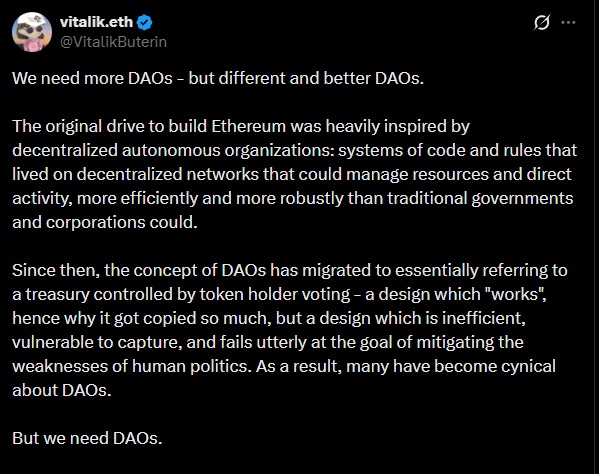
Vitalik Buterin urged the crypto community to develop “different and better” DAOs and questioned the dominant model based on token-holder voting. The Ethereum co-founder said that while this structure works at a technical level, it is inefficient from a governance perspective and vulnerable to manipulation.
Buterin recalled that Ethereum was born with strong inspiration from DAOs, conceived as systems capable of managing resources and coordinating activity more efficiently than traditional governments and corporations. However, he noted that their current design reproduces problems inherent to human politics, which has led to a loss of confidence in these structures.

Buterin Criticizes the Role of Whales in the Market
One of the central points of his criticism is the concentration of power among large holders. According to Buterin, token-based voting allows whales to exert disproportionate influence over decisions and turns governance processes into dynamics of lobbying and social pressure.
The Ethereum founder outlined specific areas where better-designed DAOs are needed. The first is oracles. He explained that token-based oracles have a structural limit: the cost of controlling a DAO cannot exceed its market capitalization. This prevents them from securing meaningful assets without extracting high rents and directly affects stablecoins, prediction markets, and other core components of the DeFi ecosystem.
Another use case is on-chain dispute resolution in advanced applications such as insurance and complex contracts, where decisions include subjective elements. He also mentioned the maintenance of shared resources, such as curated lists of secure applications, canonical interfaces, and verified token addresses. To this, he added the need for structures that can fund contributions and sustain projects over the long term after founding members step away.

Limitations and Potential Solutions
Buterin also identified two technical limitations blocking DAO progress. The first is the lack of privacy, which exposes governance systems to strong social pressure. The second is decision fatigue, caused by the need to vote frequently, which reduces participation over time.
To address these issues, he proposed integrating zero-knowledge proofs to enable private voting and making limited use of artificial intelligence to filter options and summarize positions. He clarified, however, that AI should not replace human judgment.
Finally, he emphasized that DAOs should incorporate a robust communication layer from the outset and treat institutional design as a core component of the project, not as a secondary add-on.