TL;DR
- Vitalik Buterin proposed using zero-knowledge proofs to audit social algorithms and verify their behavior without exposing code or user data.
- The framework shifts the focus from content moderation to accountability, allowing platforms to cryptographically prove what their ranking and recommendation systems optimize.
- The proposal adds blockchain-based timestamps, delayed code disclosure, and growing ZK adoption across finance, voting, and institutional systems.
Vitalik Buterin proposed applying zero-knowledge proofs to social media algorithms so their behavior can be verified without exposing proprietary code or user data.
The idea moves the debate away from content moderation and toward algorithmic accountability. Instead of demanding after-the-fact explanations or relying on public statements, platforms could cryptographically prove that their ranking, recommendation, and amplification systems meet predefined objectives. Each outcome would be backed by a verifiable proof, without revealing how the algorithm is implemented internally.
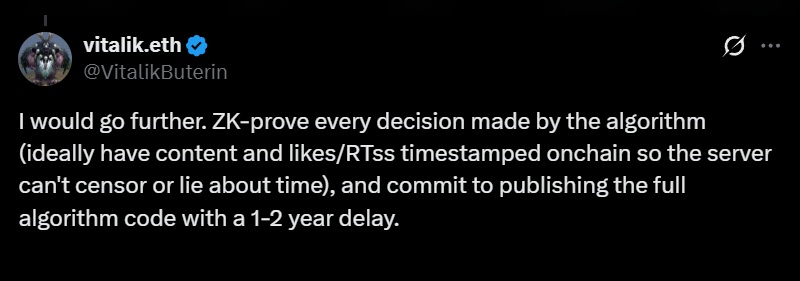
Buterin’s proposal must be understood within the broader discussion around artificial amplification, coordinated campaigns, and platforms that present themselves as defenders of free speech. Vitalik builds on an observation by Davide Crapis, AI lead at the Ethereum Foundation, who argues that any social network claiming neutrality should explain what it optimizes for. Buterin takes this one step further by arguing that such explanations should not be rhetorical, but provable.
The Impact on Contemporary Free Speech
The framework incorporates blockchain to record timestamps for content creation and user interaction. This record would make it possible to audit whether content was promoted, downranked, or modified retroactively. The goal is to reduce opaque practices such as selective suppression or post hoc manipulation of metrics, without forcing platforms to publish their code in real time.
To address operational risks and intellectual property concerns, the proposal includes a delay of one to two years before releasing the full algorithm code. During that period, zero-knowledge proofs would act as a behavioral guarantee.
The discussion also challenges the limits of the “more speech” argument. Buterin warns that coordinated amplification and AI-driven bot networks can generate large volumes of synthetic engagement. In that environment, purely organic responses lose effectiveness and ultimately erode the credibility of open platforms.
Buterin also proposes combining zero-knowledge proofs with other cryptographic systems such as multi-party computation, fully homomorphic encryption, and trusted execution environments. One of the most sensitive use cases is voting systems, where privacy and resistance to coercion are central to on-chain governance.
Buterin Works to Reduce the Cost of ZKPs
By 2025, protocols based on zero-knowledge technology exceed $28 billion in total value locked. Institutions such as Goldman Sachs, Sony, and Deutsche Bank already use ZK rollups for transactions, NFTs, and other compliance-related processes. More than $100 billion in stablecoin transfers are executed on these layers.
In addition, technical advances such as the GKR protocols developed by Buterin himself reduce verification costs and allow full nodes to run on standard hardware. That combination of auditability, efficiency, and privacy could redefine the practical scope of algorithmic transparency