TL;DR:
- Vitalik Buterin detailed Ethereum’s plan to reduce slot times from 12 seconds to just 2, bringing finality down to between 6 and 16 seconds.
- The Ethereum Foundation’s “strawmap” projects seven forks through 2029, targeting massive throughput, post-quantum security, and native privacy.
- The changes include P2P networks with erasure coding, fewer attesters per slot, and a gradual replacement of the consensus system in a “Ship of Theseus” fashion.
Vitalik Buterin published a comprehensive analysis of the Ethereum Foundation’s new “strawmap“, the long-term technical roadmap aimed at transforming the network’s base layer through seven forks projected through 2029. The document, originally presented by researcher Justin Drake, carries no official status but serves as a coordination tool for development teams.
The central focus of Buterin’s analysis is the acceleration of the protocol at the consensus layer. Ethereum currently records an average finality of 16 minutes, derived from the combination of 12-second slots, 32-slot epochs, and the finalization process under Gasper. The proposal aims to decouple both variables in order to optimize them independently.
Buterin Targets Less Time and More Certainty
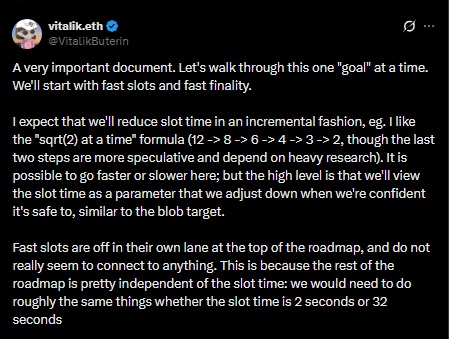
For slot reduction, Buterin proposed an incremental formula based on the √2 factor: the path would go from 12 seconds to 8, then 6, 4, 3, and eventually 2, though the final steps depend on further research. Each reduction would only be implemented when there is sufficient evidence that it is safe, following a logic similar to the one governing blob target adjustments.
One of the key technical factors is an optimized P2P layer developed by researcher Raúl Kripalani, which uses erasure coding to improve block propagation. The scheme divides each block into reconstructible fragments from any sufficient subset, which reduces propagation times without compromising security. This allows slot times to be shortened without introducing additional risks.
For finality, the protocol aims to adopt a single-round BFT algorithm known as Minimmit, which could bring finality to between 6 and 16 seconds in its final state. The projected trajectory passes through multiple intermediate stages: from the current 16 minutes to 10 minutes with 8-second slots, then to minute-scale ranges, and finally to seconds via Minimmit with progressively more aggressive parameters.

The Plan Beyond Consensus
Buterin also anticipated that the most invasive changes, including the migration to hash-based post-quantum signatures, will be grouped into a gradual replacement of the consensus system. This “Ship of Theseus” strategy involves substituting components one by one until reaching a simpler architecture, resistant to quantum computers and formally verifiable end to end.
The full roadmap also contemplates gigagas throughput on L1, teragas scaling on L2, and native privacy, positioning Ethereum ahead of a deep structural transformation that will extend at least through the end of the decade.