TL;DR:
- ADA can now be staked directly from hardware wallets with zero fees until March 2026 through a new staking integration.
- Users retain full control of private keys while earning estimated annual rewards between 2 % and 2.5 %.
- The model combines cold‑storage security with passive income potential, reinforcing Cardano’s long‑term staking growth outlook.
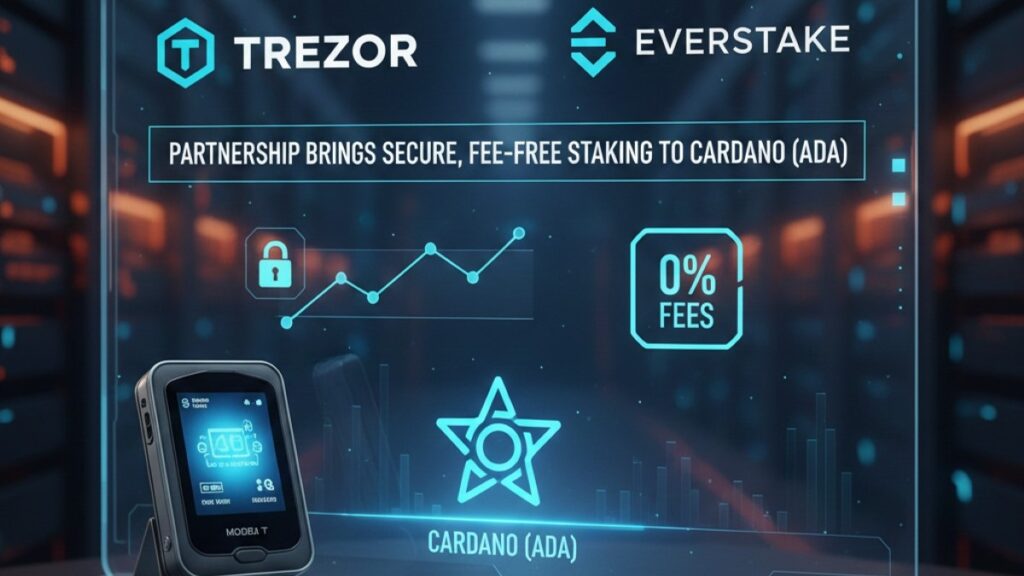
Cryptocurrency holders looking for a secure and self‑custodial way to stake Cardano now have a new option. Thanks to a recently launched collaboration between Trezor and Everstake, ADA holders can now stake directly from their hardware wallets with zero fees until March 2026. The integration works through the Trezor Suite app and supports multiple Trezor models, offering a blend of security, control, and convenience for long‑term investors.
1/2 You can now stake @Cardano's $ADA with Everstake through @Trezor Suite at a 0% validator fee for four months!
✔️ This means you'll enjoy a complete waiver of the standard 4% fee throughout the campaign. Don't miss out!
Download Trezor: https://t.co/VSkHzxFwC3 pic.twitter.com/amtC330OBR
— Everstake (@everstake_pool) December 4, 2025
Staking ADA through this setup keeps private keys offline at all times, reducing exposure to third‑party risks. Users can manage staking without transferring funds to external platforms. This non‑custodial approach ensures full ownership of funds while still allowing participation in network validation, reflecting a broader shift toward self‑sovereignty in the digital asset space.
Under the promotional structure, staking via this solution carries no commission fees for a limited time, which significantly boosts net returns. Rewards from ADA staking are distributed per epoch and are estimated to reach between 2 % and 2.5 % annually, depending on pool performance. For passive investors, the ability to earn yield without fees creates an attractive risk‑reward balance while maintaining a strong security profile.
The timing of this rollout aligns with increased awareness of custody risks following multiple high‑profile platform failures. As users prioritize hardware‑level protection and direct asset control, solutions that merge cold‑wallet security with yield‑generation tools are gaining rapid traction. For many market participants, this model removes the long‑standing tradeoff between safety and opportunity.
Looking ahead, the impact of this partnership will depend on how quickly ADA holders adopt the zero‑fee staking model. If participation rises meaningfully, the network could benefit from greater decentralization and improved security. For individual users, the initiative offers a rare combination of cost‑free staking, institutional‑grade security, and full asset control, strengthening Cardano’s appeal as a long‑term staking ecosystem.