The crypto sector has accelerated deployment of tokenized securities platforms over the past eighteen months. Venture-backed startups build infrastructure to migrate equities and fixed income to blockchain. Market participants project trillion-dollar volumes. Policymakers draft regulatory frameworks. Yet one operational requirement remains systematically underexamined: the structural necessity of segregated cash reserves.
The crypto narrative promises elimination of intermediaries. If securities exist as tokens, settlement friction disappears. Clearing cycles compress to minutes. Third-party custodians become redundant. Operating costs plummet. The vision appeals to believers. Yet it mistakes architectural desire for operational reality.
Atomic Settlement and Liquidity Constraints
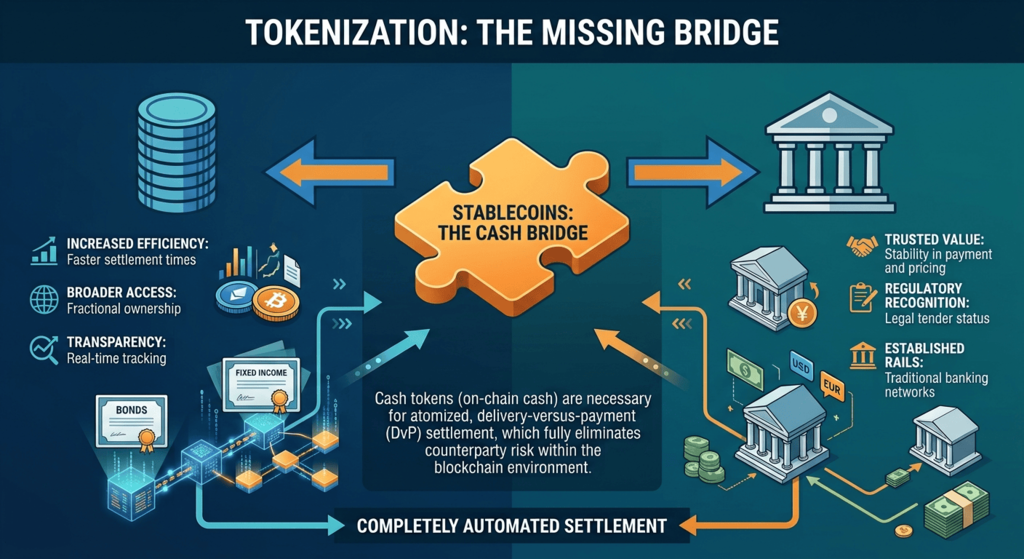
Tokenized equity and debt markets demand immediate liquidity at settlement. A buyer transfers payment tokens. A seller transfers security tokens. Both legs must execute simultaneously. If the buyer lacks sufficient balance at settlement confirmation, the transaction fails.
Traditional equity markets address this via multi-day clearing windows. T+2 settlement creates temporal buffers. Central counterparties guarantee completion. Custodians audit holdings. The tradeoff accepts operational delay to ensure certainty.

Blockchain promises T+0 settlement. This requires both counterparties to maintain real-time available balances. An institutional investor holding five hundred million in equities cannot maintain that figure in ethereum or solana balances. Regulatory risk limits prohibit it. Cost of capital expenses prohibit it. Balance sheet constraints prohibit it.
Proposed solutions default to stablecoins. Investors deposit fiat, receive USDC or USDT, execute transactions. But stablecoins are not cash. They are cash derivatives with counterparty risk. Circle, Tether, and Paxos issue these tokens. Each issuer introduces distinct failure modes.
Stablecoin Volatility and Counterparty Risk
Stablecoin history reads as a cascade of depeg events. USDT lost peg in March 2023. USDC experienced pressure following Silicon Valley Bank’s collapse. BUSD, backed by Paxos, faced discontinuation via regulatory action. Each incident creates subsequent uncertainty.
An institutional investor executes a bond purchase on-chain. Uses 10 million USDC for settlement. Next trading day, regulators communicate concerns about Paxos or media reports scrutinize Circle. USDC experiences 0.5% to 2% price variation. In leveraged derivatives or structured positions, this moves the P&L line.
The counterparty risks inherent to stablecoins are structural, not circumstantial. Each issuer maintains reserves. Those reserves sit in commercial banks. Commercial banks carry credit risk. Audits attest to reserve composition, not to absence of risk. A single banking failure, a corporate liquidity event, or regulatory review triggers redemption stress.
Operational Requirement for Cash Segregation
Securities markets in regulated finance operate with segregated cash deposits. An investor purchases equities. The broker maintains investor cash in a segregated client account. That cash sits under legal custody. Regulatory bodies conduct recurring audits. Cash belonging to clients is physically separated from corporate cash of the broker.
In blockchain, the parallel logic must replicate. A tokenized securities platform requires a cash vault. Users deposit fiat currency. That currency does not enter platform operations. It does not collateralize a protocol. It does not serve as collateral for lending facilities. It remains segregated by legal and operational necessity.

But where does that cash vault exist? On a blockchain, the answer exposes architectural limits. An ethereum smart contract cannot operate as a bank. A multi-signature solana wallet cannot fulfill regulated custody functions. Real cash resides in regulated banks. That requires traditional financial institutions as counterparty.
An inescapable reality emerges: tokenized securities without banking intermediaries are operationally impossible. Cash must reside in a bank. Banks operate under regulatory supervision. Regulatory supervision requires an institution to assume legal accountability. This means intermediaries do not vanish; they transform structure.
On-Chain Purism and Cost Inefficiency
Securities would tokenize. Settlement would occur in stablecoins. Users would convert fiat to stablecoins via exchanges. The flow becomes: bank → exchange → stablecoin conversion → blockchain transaction → settlement → redemption of stablecoin → exchange withdrawal → bank account.
Aggregating total costs: deposit fees, exchange spreads, stablecoin peg slippage, transaction gas, withdrawal fees. The sum materially exceeds traditional brokers operating direct interbank clearing.
Investment funds do not hold material stablecoin positions due to audit, tax, and regulatory compliance requirements. Their accounting systems operate in fiat currency. Their regulatory filings report in fiat currency. Their audited transactions settle in fiat currency. Converting to stablecoins introduces unresolved regulatory complexity and tax-code ambiguity.
An opposite model emerges: platforms maintaining segregated cash in regulated banks, enabling direct fiat deposits, issuing security tokens backed by escrow deposits. Users transmit funds via ACH or bank wire. Security settlement occurs on-chain. Withdrawals process to the user’s bank account.
Hybrid Models as Operational Standard
Protocols like Synthetix and Aave managing derivatives discovered years ago that hybrid models are the only operationally viable design. Users deposit stablecoins. Protocols provide synthetic markets. Withdrawals process in stablecoins. Stablecoins remain anchored to banking system liquidity. Banking system counterparty risk becomes the underlying systemic risk.
Tokenization projects including Polymarket, Goldfinch, and Securitize operate with analogous architecture. Users transfer funds through regulated on-ramps. Those funds deposit into custodial banks. Security tokens issue against those deposits. Settlement executes on-chain. Withdrawals process through regulated off-ramps.

What advantages exist versus traditional markets? Settlement velocity, ledger transparency, around-the-clock market access, and reduced redundancy in custody infrastructure. Intermediary custodians diminish because blockchain becomes the property ledger. But banking counterparties do not diminish. They become structural requirements.
Regulatory Risk and Incentive Misalignment
Additional risk surfaces: if platforms maintain segregated deposits in banks, they operate functionally as deposit institutions. This requires banking licenses or bank partnerships assuming reputational risk for crypto-adjacent custody.
The supply of banks accepting this risk is declining, not expanding. Post-FTX and post-crypto.com, institutions systematically reduce crypto exposure. Reputational cost outweighs margin potential.
Therefore, tokenization platforms face dual constraint:
- Require segregated cash in regulated banks
- Encounter restricted supply of banks providing services
This creates natural monopolies. First-mover establishing stable banking relationships captures disproportionate market share. Later entrants pay higher costs or face scaling restrictions.
Protocol Architecture Implications
The operational conclusion: tokenized securities protocols must encode segregated cash flow as first-class primitive. Not as secondary mechanism, but as foundational architectural component. Protocol designers must specify:
- Deposit mechanics: fiat inflow pathways to segregated cash vault
- Segregation guarantees: audit protocols confirming deposit isolation
- Redemption mechanism: how users convert security tokens to fiat
- Bank failure treatment: what occurs if custodian bank faces illiquidity
- Cash fallback: emergency liquidity sourcing through diversified stablecoins
Protocols ignoring this requirement build theoretical systems. They function until stress emerges. Stress exposes architectural fiction.
Settlement Finality and Regulatory Reporting
Another dimension: securities settlement carries regulatory reporting obligations. Transactions must record in immutable form. Compliance departments must audit transaction history. Regulators must access records on demand.
It does not solve regulatory reporting interoperability. A compliance officer at an investment bank needs transaction confirmation in formats compatible with existing surveillance systems. Those systems operate in fiat currency reporting. Converting to blockchain-native formats requires middleware translation layers.
Each translation layer introduces operational risk and additional cost. The savings promised by blockchain get partially absorbed by reporting infrastructure.
Institutional Adoption Realities
Institutional investors evaluate platforms on operational compliance, risk transparency, and cost structure. They do not prioritize blockchain maximalism. They prioritize certainty.
A pension fund custodian accepts deposits through regulated channels. Monitors cash segregation through audited reports. Settles transactions through proven infrastructure. Distributes profits in fiat. This workflow has operated for decades. Changing it requires demonstrable efficiency gains, not philosophical superiority.
Tokenized securities platforms winning institutional adoption are those building regulated infrastructure with blockchain as settlement layer, not those proposing crypto-only flows.