The digital asset market has reached a turning point that can only be described as the “endgame.” This is not just another cycle of volatility; we are witnessing a profound restructuring where consumer sentiment—currently at historical levels of apathy—contrasts violently with an institutional infrastructure being wired behind closed doors. What many perceive today as an endless winter is, in reality, the most strategic accumulation phase of the decade.
The Sentiment Abyss: Purging the “Weak Hands”
The recent indifference following high-profile events, such as the lukewarm reception of crypto advertising during the Super Bowl, confirms a harsh reality: the retail investor is exhausted. The Crypto Fear & Greed Index recently bottomed out at a level of 5 out of 100, a psychological abyss that coincides with Bitcoin (BTC) oscillating in the $60,000 – $70,000 range.
This 50% drawdown from highs has triggered a necessary capitulation. For the professional investor, this widespread “hatred” toward the ecosystem is the most reliable indicator that weak hands have abandoned the ship. It is in this vacuum of optimism that the foundations for the next aggressive move are being laid.

Geopolitics and Debt: Checking the Treasury Bonds
The true bullish thesis today lies not in Bitcoin’s code, but in the treasuries of Asia. A tectonic shift has begun: China has formally instructed its major financial institutions to limit exposure to U.S. Treasury bonds, reducing its holdings to levels not seen since the 2008 crisis (approximately $683 billion).
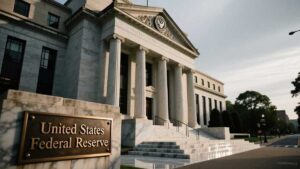
This withdrawal of major debt buyers puts the Federal Reserve in a “check” position. If external demand collapses, the Fed will be forced to reactivate massive liquidity (Quantitative Easing), becoming the lender of last resort. In this scenario of global fragmentation, Bitcoin stops being a speculative asset and splits into two vital roles:
- Peacetime Bitcoin: A simple inflationary hedge.
- Wartime Bitcoin: A sovereign reserve asset and a refuge from systemic distrust.
The Changing of the Guard: Toward a “Dovish” Fed?
The nomination of Kevin Warsh to lead the Federal Reserve on January 30, 2026, marks a paradigm shift. Although his track record is that of a “hawk” advocating for monetary discipline, his understanding of Bitcoin as a thermometer for the system’s health suggests a pragmatic transition.
With real inflation beginning to show signs of fatigue (projected at 2.36% for this month), the Fed could be forced to execute more aggressive rate cuts than anticipated to avoid a recession, aiming for a target near 3.1% by year-end. This shift toward liquidity usually precedes V-shaped recoveries in risk assets, especially for Ethereum, which is currently struggling to maintain the $2,000 mark.
Institutional Landing: The Silent Infrastructure
While the price moves sideways, the speed of banking integration is dizzying. This is not a prediction; it is a quantitative fact: it is estimated that two-thirds of financial institutions will have integrated crypto solutions before the end of the next semester.
Today, the ecosystem no longer relies solely on retail speculation, but on robust legal frameworks such as the Clarity Act and the GENIUS Act, which have allowed the U.S. to consolidate a strategic reserve of approximately $29 billion in Bitcoin. We are seeing giants like JPMorgan and Ripple collaborate on the design of a financial system where stablecoins are the new standard for instant settlement.

Final Reflection: Surviving Volatility
The current landscape demands a clear distinction: price noise vs. adoption signal. We are looking at an asset that, much like Amazon in its early days, subjects its investors to 50% drops to filter out those who do not understand the change in monetary regime.
The key is not guessing if the $60,000 support will hold, but understanding that we are facing the “Endgame” of a traditional financial model desperately seeking new rules. In this new order, volatility is not a defect; it is the tool that transfers wealth from the impatient to institutional hands. Proceed with caution, but understand that in 2026, change is no longer a possibility—it is a structure that is nearly finished setting.