TL;DR
- Tether launches a local AI system called QVAC Fabric LLM that allows users to run and train models on consumer hardware without relying on the cloud.
- The software supports inference and LoRA fine-tuning on GPUs and mobile chips, and uses binaries and adapters from Hugging Face to speed up adoption.
- The company pushes a decentralized AI model amid ongoing financial concerns, which could limit early institutional interest.
Tether released QVAC Fabric LLM, a system that enables running and training language models (LLMs) directly on consumer devices —laptops, PCs, home GPUs, or phones— without relying on the cloud. The company aims to bring artificial intelligence into decentralized environments, offering privacy and autonomy while avoiding the costs and vulnerabilities associated with centralized infrastructure.
The new software supports local inference, LoRA training, and instruction-tuning. It works with GPUs from AMD, Intel, NVIDIA, and Apple Silicon, as well as mobile chips such as Qualcomm Adreno and ARM Mali.
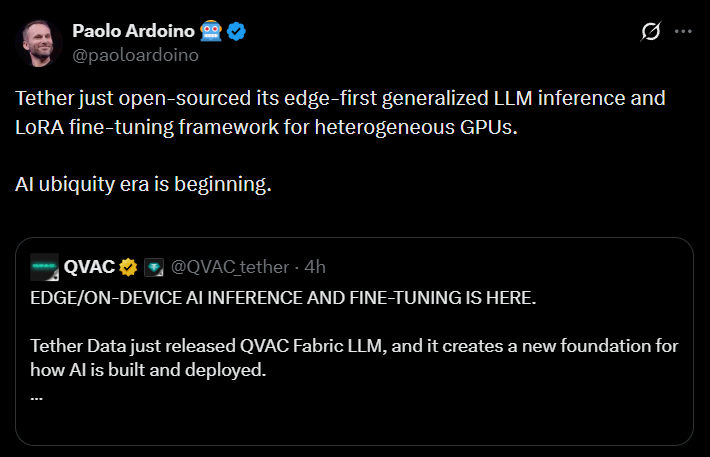
According to Tether, this allows “personalized AI to learn from the user” and operate offline in areas with limited connectivity. Developers only need “a few commands” to get started. QVAC Fabric LLM is released under the Apache 2.0 license. The launch includes multi-platform binaries and prebuilt adapters available on Hugging Face, easing integration and adoption.
Strategic Repositioning
Tether’s move into AI marks a full strategic shift. Known until now for issuing the world’s largest stablecoin, the company is diversifying its technological infrastructure. This decision comes as demand for decentralized AI increases and emerges as a viable option for organizations or individuals seeking control over their data at lower cost.
It is worth noting that the firm was recently downgraded by S&P Global Ratings to a “5 (weak)” risk level, raising questions about the transparency of its reserves. BitMEX co-founder Arthur Hayes also warned that Tether’s growing exposure to Bitcoin and gold could threaten its solvency if those assets were to fall 30%. That backdrop introduces doubts about the financial capacity behind any aggressive expansion plans.
Tether May Struggle to Promote QVAC Fabric LLM
The pressure surrounding the company may affect institutional adoption of QVAC Fabric LLM. Investing in a new AI infrastructure developed by an entity facing regulatory and financial scrutiny carries certain risks. Still, the ability to offer local, secure, and low-cost AI could appeal to sectors focused on privacy or located in areas with limited connectivity.
Tether is moving beyond stablecoins and proposing a new model of open and accessible infrastructure. If it manages to overcome financial doubts, QVAC could signal the beginning of decentralized AI at scale, accessible from a phone or laptop without depending on expensive servers or centralized platforms