TL;DR
- Soulja Boy returned to controversy after apologizing for promoting failed projects. His track record continues to generate spillover effects across the industry.
- An investigation by ZachXBT uncovered 73 crypto promotions and 16 NFT projects between 2021 and 2023, many tied to collapses, abandonments, and rug pull schemes.
- The controversy resurfaced when a Base cofounder promoted a meme token linked to the rapper.
Soulja Boy once again became a focal point in the crypto industry, but this time the attention extended beyond his past promotions to how his track record continues to produce collateral effects across the ecosystem.
The controversy reignited after the rapper himself issued an apology for having promoted dozens of crypto and NFT projects that later turned out to be scams, just as a key figure at Base promoted a new meme token associated with his name.
ZachXBT Exposed Soulja Boy
The initial trigger was an investigation by ZachXBT, who documented that Soulja Boy promoted at least 73 crypto projects and 16 NFT collections between 2021 and 2023. Many of those assets collapsed shortly after the posts, were abandoned, or displayed patterns typical of rug pulls.
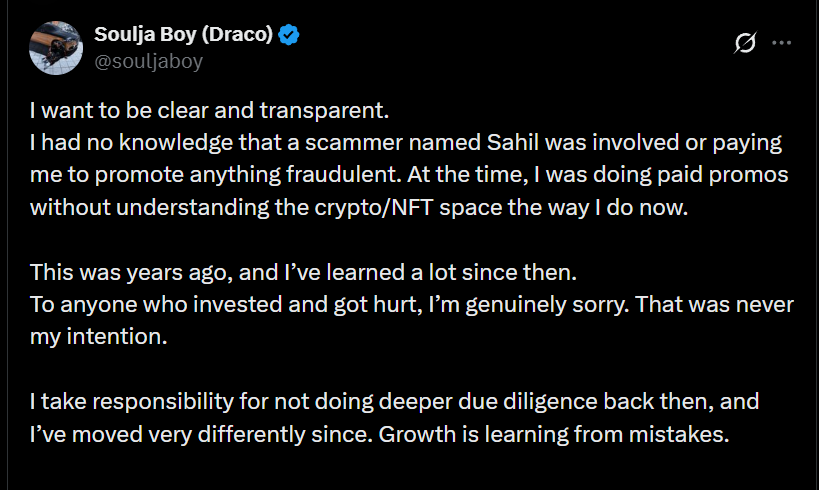
The investigator estimated that the artist earned more than $730,000 in payments from those promotions. In response to that exposure, Soulja Boy posted a message on X acknowledging errors in judgment, stating that he was unaware of the fraudulent nature of the projects, and accepting responsibility for not conducting deeper analysis at the time.
However, his apology did not put the issue to rest. A few days later, Jesse Pollak, a cofounder of Base, publicly shared a meme token associated with Soulja Boy to showcase a creator payment feature on the network. The reaction was immediate. Developers, on-chain analysts, and traders questioned why a prominent figure from a Coinbase-backed blockchain would highlight an asset tied to such a problematic history.

Controversy at Base
ZachXBT stepped in again and resurfaced his 2023 investigation, bringing the controversy back to the forefront. The core of the debate centered less on the token’s legality and more on the responsibility involved in promoting it. For many users, a promotion from an account with that level of visibility is not perceived as a simple technical example, but as an implicit signal of validation.
Defenders of Pollak pointed to the permissionless nature of Base. Anyone can launch tokens, anyone can use them, and the infrastructure does not discriminate. Still, that explanation failed to ease the backlash. One thing is protocol neutrality, and another is the public influence of those who build it. The visibility of a cofounder changes how the message is interpreted, even when there is no explicit intent to endorse.
Open networks promise neutrality, but the people who lead them carry reputational weight that is anything but neutral. In the crypto market, trust is not defined solely by on-chain rules or regulatory frameworks. It is also built, or eroded, through social signals