TLDR
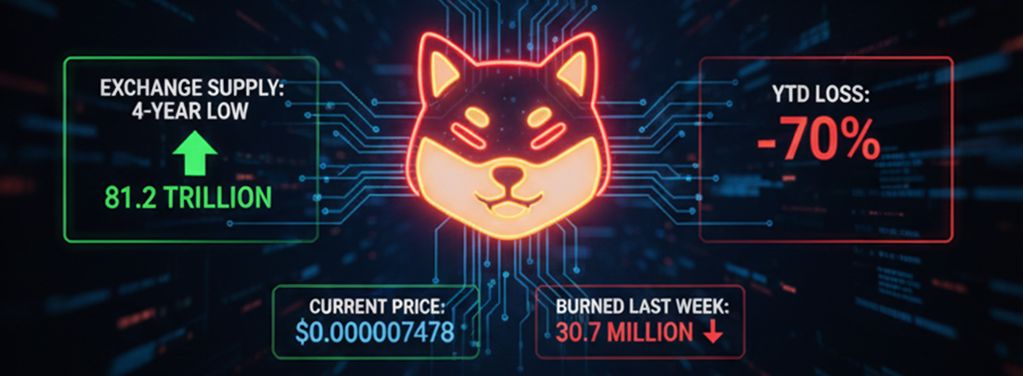
- SHIB supply on centralized exchanges has dropped to 81.2 trillion, its lowest level since April 2021.
- The asset has fallen out of the crypto market “Top 30” following a price decline of over 70% on a yearly scale.
- Analysts believe that retail capitulation is a buy signal for “smart money.”
As 2025 draws to a close, the second-largest memecoin in the ecosystem faces a critical crossroads. With its price currently hovering around $0.000007478, the market is wondering if a long-awaited Shiba Inu comeback is just around the corner.
CryptoQuant data reveals that the amount of SHIB tokens stored on centralized platforms has dropped to levels not seen in four years, which traditionally reduces immediate selling pressure and sets the stage for a potential bullish momentum.
Despite the pessimism surrounding the asset—currently ranked 35th by market capitalization—this exhaustion of exchange supply is viewed by experts as a positive technical signal.
Expert analyst Lyvo suggests that SHIB has reached its “real bottom,” arguing that while retail investors abandon their positions due to a lack of faith in “old” projects, whales and “smart money” are accumulating medium-term exposure.
Persistent Challenges: Token Burns and the State of Shibarium
Undoubtedly, the path toward a Shiba Inu comeback is filled with significant obstacles. The token-burning mechanism has shown a recent slowdown, with only 30.7 million SHIB removed in the last week, representing a 14% decrease compared to the previous period.
With a circulating supply that still exceeds 585 trillion tokens, the impact of these burns remains limited in terms of drastically influencing the asset’s scarcity.
On the other hand, the Layer 2 network, Shibarium, has failed to regain its momentum following the security issues suffered in September. The stagnation in daily transaction processing has detracted from the ecosystem’s utility, a factor that bears are using to maintain control over the price.
In summary, the success of any Shiba Inu comeback in 2026 will depend on the low exchange supply, but also on the development team’s ability to revitalize confidence in its technological infrastructure.