TL;DR:
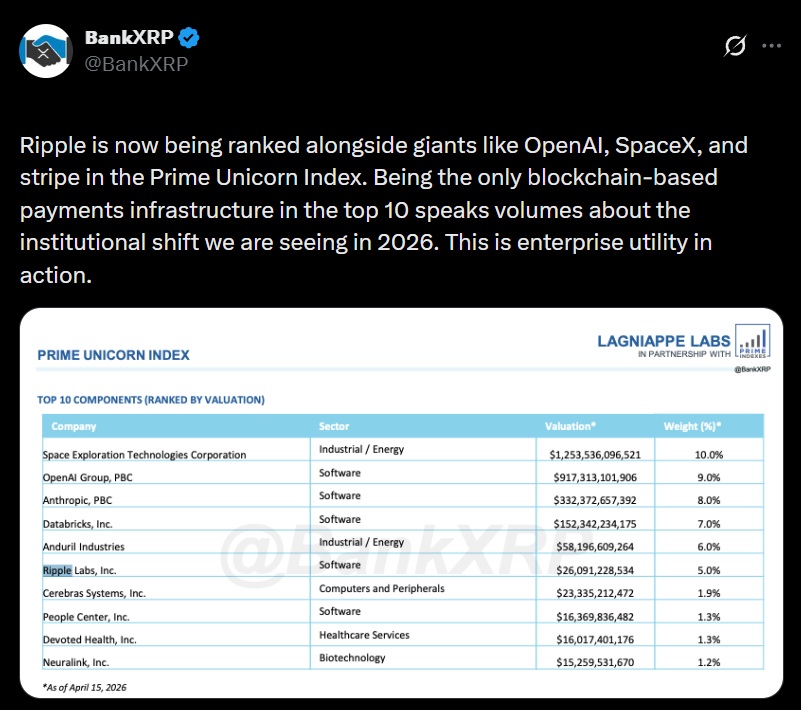
- Ripple joined the Prime Unicorn Index alongside OpenAI, SpaceX, Databricks and Stripe, as the only blockchain infrastructure company among the top ten.
- The company participated in a pilot with Mastercard, Ondo Finance and JPMorgan Chase to test a tokenized Treasury redemption flow on the XRP Ledger.
- Ripple is currently running a $25 million education program in the United States.
Ripple joined the Prime Unicorn Index and was positioned alongside OpenAI, SpaceX, Databricks and Stripe, companies that define the direction of artificial intelligence, space exploration, data systems and payment systems. It is the only blockchain infrastructure company among the top ten in the index, which shows that the institutional sector is seriously evaluating distributed ledger technology.
Ripple’s presence in that ranking is not driven by market speculation but by real adoption criteria. The index measures high-impact private companies, and its inclusion indicates that blockchain infrastructure is already considered part of the foundational stack that supports commerce, communication and the movement of capital at a global scale.
Ripple: The Leap From Experimental to Essential
That recognition is backed by concrete facts. Ripple worked alongside Mastercard, Ondo Finance and JPMorgan Chase to test a U.S. tokenized Treasury redemption flow on the XRP Ledger, integrated with traditional banking rails. The experiment showed that digital assets and traditional finance are moving toward interoperability, where tokenized instruments are functioning as a bridge between both systems.
This pilot not only demonstrated technical capability, but also institutional willingness. That three actors as different as a global payment network, a real-world asset firm and one of the largest banks on the planet chose the XRP Ledger as their testing environment speaks volumes about where institutional trust is concentrated today.
Beyond Financial Markets
On another front, Ripple is currently running a $25 million education program in the United States aimed at strengthening learning environments. One year after its launch, schools that have participated in the program report better access to digital tools, updated infrastructure and expanded STEM resources. The initiative is less visible than its financial moves, but responds to the same logic of applying enterprise technology to real-impact infrastructure.
The inclusion in the Prime Unicorn Index, the pilots with financial giants and the deployment in the public sector form a maturation cycle that positions Ripple as a practical architecture within economic systems — one that still has much left to build and prove.