TL;DR
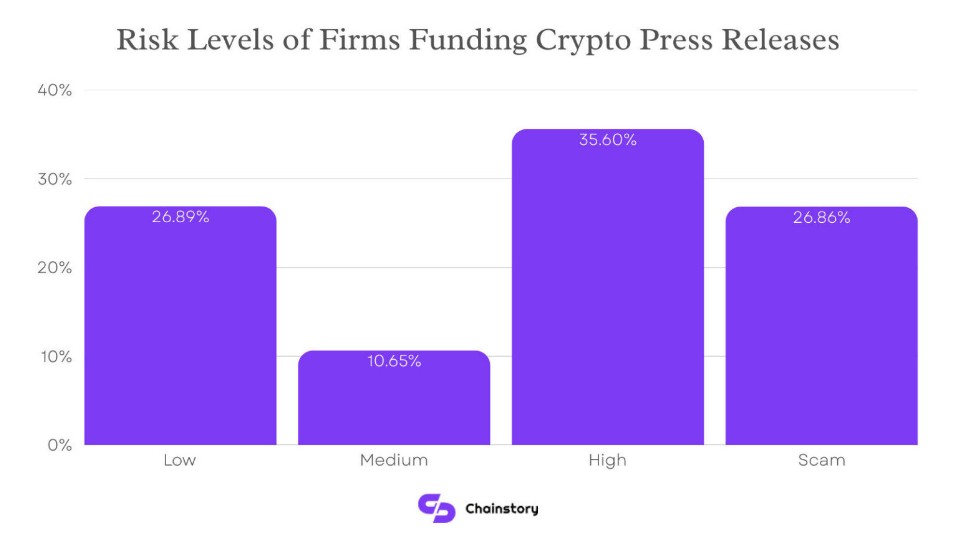
- A Chainstory report reviewed 2,893 press releases and found that 62.5% came from high-risk projects or outright scams.
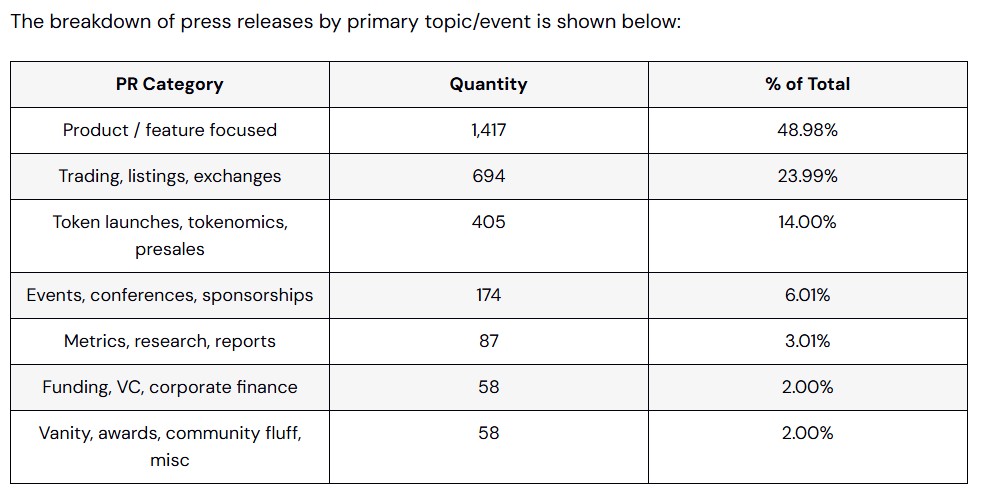
- Most of the releases focused on product announcements, listings, and commercial campaigns; exchanges accounted for nearly a quarter of the total analyzed.
- The use of replicated mass announcements was linked to prior cases of manipulation, with documented instances where false releases preceded sharp price spikes.
Between June and November 2025, most press releases published in the crypto sector came from projects classified as high risk or directly fraudulent.
A report by communications firm Chainstory analyzed 2,893 press releases and determined that 62.5% were tied to high-risk activity or scams. Within that total, high-risk projects accounted for 35.6%, while scams represented 26.9%. Low-risk projects made up only 27% of the releases analyzed.
The Role of Exchanges
The study classified issuers based on cumulative signals. Incomplete data alone was not enough to raise a project’s risk level. A high-risk classification was assigned only when multiple independent red flags were identified, such as unrealistic yield promises, cloned websites, the absence of identifiable teams, or repeated patterns of misleading communication. Low-risk projects featured doxxed teams and no unresolved security incidents.
The content of the releases concentrated on product announcements, new features, exchange listings, and trading campaigns. That group accounted for 74% of the total. Exchanges ranked among the most active communicators, with nearly a quarter of all announcements linked to listings, promotions, or trading activity. Mass distribution served as a mechanism to publish proprietary narratives without editorial mediation.
Chainstory identified the recurring use of shotgun distribution, which replicates the same release across dozens of sites through syndication services. Search engines typically filter out duplicated content and index only one or two versions, reducing organic visibility despite the high volume of publications.
Mass Press Releases: A Core Tool in Pump-and-Dump Schemes
The report linked this practice to documented cases of market manipulation. A cited academic study based on SEC-investigated cases between 2002 and 2015 showed that 73.3% of pump-and-dump schemes used press tools as the primary channel to spread false or misleading information. In addition, Chainstory recorded price movements following sequences of releases announcing partnerships or developments that never materialized.
The report included several concrete examples. In 2021, a false press release claiming that Walmart had adopted Litecoin triggered a 30% price surge before being debunked. In December 2025, a project posing as Circle circulated a misleading announcement that prompted users to connect their wallets. In 2023, the JPEX exchange published releases portraying itself as a licensed platform; months later, Hong Kong’s regulator confirmed that it did not hold such authorization.
Chainstory concluded that, in the crypto space, low publication friction and the lack of editorial controls allow press releases to function as a dominant channel for high-risk projects, crowding out communication from issuers with lower exposure to aggressive promotional practices