TL;DR
- Ray Dalio warns investors to stop comparing Bitcoin to gold as a store of value.
- Dalio criticizes Bitcoin’s lack of privacy and its transparent public ledger.
- He argues Bitcoin correlates with tech stocks, unlike gold’s stable market depth.
Billionaire investor Ray Dalio has once again shared his views on Bitcoin, delivering a clear message: investors should stop comparing the cryptocurrency to gold. During his appearance on the “All-In Podcast” on March 3, the founder of Bridgewater Associates outlined a series of criticisms against Bitcoin, arguing that the digital asset fails to meet the standards he considers essential for a reliable store of value.
Dalio confirmed that he holds a position in Bitcoin, approximately 1% of his portfolio, as part of a diversification strategy. However, he made it clear that this allocation does not stem from a deep conviction about its monetary qualities, but rather from the need to hedge against risks in an uncertain environment.
Dalio’s definition of money
The investor explained that his preference for gold over Bitcoin responds to a very specific conception of what constitutes money. “Money mechanistically is debt,” he said during the interview.
When someone holds fiat currency, he argued, they actually hold a promise issued by a central authority. When debt levels grow too high, central banks have the power to print more money, which dilutes the value of that promise.
For this reason, Dalio seeks assets with physical limitations. “I want an asset that’s got some physical limitation to it,” he stated. “Gold is the only long-term historic asset for reasons.” Unlike government-issued currencies, the precious metal cannot be artificially created, has global recognition, and can be transferred between countries without relying on a counterparty’s promise.
Central banks appear to share this view. Dalio noted that in recent years these institutions have steadily increased their gold reserves amid economic and geopolitical uncertainty.
Bitcoin and the absence of privacy
One of Dalio’s strongest criticisms against Bitcoin focused on the forced transparency of its network. “Bitcoin does not have privacy. Any transaction can be monitored and directly, perhaps, controlled,” he warned.
The investor added that central banks are unlikely to embrace an asset that operates on a fully public ledger. This characteristic, far from being an advantage in terms of transparency, represents for Dalio an insurmountable obstacle if the cryptocurrency aspires to become an institutional reserve asset.
He also raised a long-term technological concern: quantum computing could potentially threaten Bitcoin’s cryptographic security in the future. Although this scenario remains distant, Dalio mentioned it as an existential risk that gold does not face.
Beyond technology, the Bridgewater Associates founder pointed to market ownership dynamics. “Bitcoin tends to have a pretty high correlation with tech stocks,” he explained. “From an ownership perspective, supply and demand can be affected if somebody gets squeezed in one area and has to sell something else they hold.“
In his view, Bitcoin remains a relatively small and, in some ways, controllable market. This characteristic makes it vulnerable to sharp movements caused by forced liquidations in other markets, something that does not occur with gold due to its greater depth and liquidity.
Dalio’s statements come at a time when gold itself is experiencing some weakness in the markets. During the fifth day of the conflict between the United States and Iran, the precious metal recorded a drop of $168, a 3.07% decline, trading at $5,128.58 per ounce.
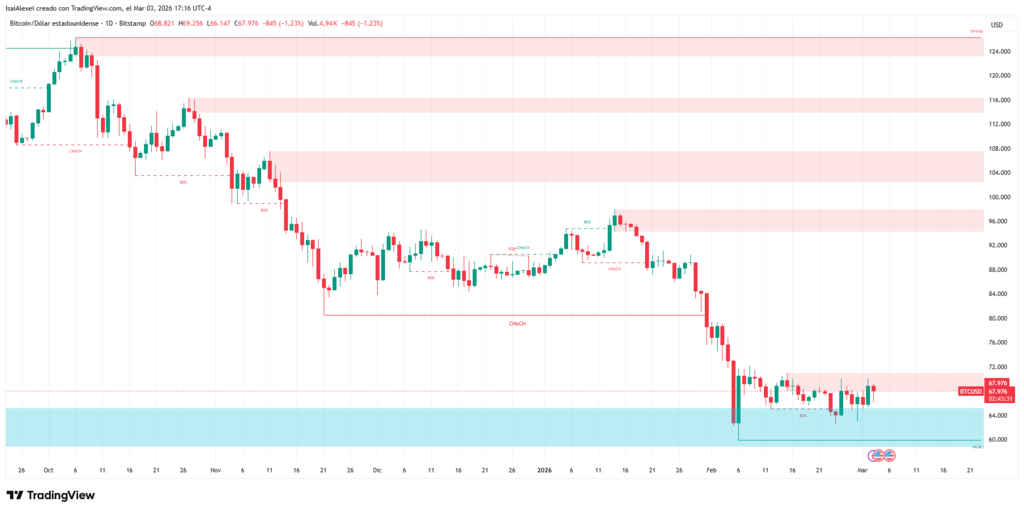
Bitcoin, meanwhile, showed relatively greater resistance. BTC was trading at $68,707.30, down just 0.7% over the past 24 hours. This difference in behavior suggests that, at least in the short term, Bitcoin investors did not react with the same intensity as gold investors to geopolitical tensions.
Dalio, however, maintains his critical stance. For him, the function of money is not only to preserve value in times of calm, but to do so when traditional systems show cracks. In that scenario, he considers that gold has proven its effectiveness for centuries, while Bitcoin still needs to demonstrate that it can withstand multiple economic and technological cycles without losing its essence.