

Meme coins in 2025 continue to draw attention for their character-driven branding and social-media-led communities. Projects featuring frogs, dogs in hats, and other internet in-jokes have remained a visible corner of the market, with names such as Pepe and Doginme frequently referenced in online discussions.
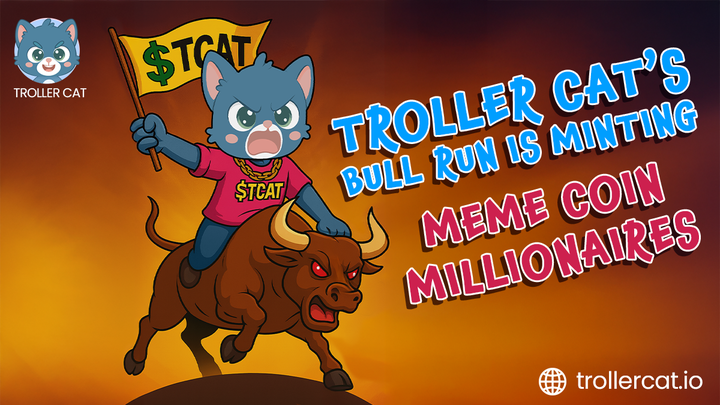
One project that has attracted attention in this category is Troller Cat, which the team describes as an Ethereum-based meme token with a staged token-sale structure. According to the project, it has raised approximately $425K to date in a later stage of its token sale. The project also describes marketing incentives (including a referral program), though such incentives are not independently verified and do not change the risks associated with cryptoassets.
1. Troller Cat ($TCAT)
Troller Cat positions itself around a series of themed stages and references to internet “trolling” culture. Project materials describe a stage-based token-sale format and a narrative roadmap tied to meme history and community engagement.

The project has published figures and stage labels for its token sale, but those figures should not be treated as an indicator of future performance. Claims about wallet counts, demand, or outcomes may change quickly and can be difficult to verify in real time across platforms.
Roadmap Highlights
In its roadmap, Troller Cat describes several phases that include a decentralized exchange launch, possible centralized exchange listings, and planned features such as games and community governance. The project also states it intends to implement a liquidity lock for a defined period after launch and to introduce staking with vesting mechanics, which it says are designed to discourage immediate selling.
Later phases, as described by the team, include a “Game Center” concept and token-supply reduction mechanisms (such as buybacks and burns) funded through advertising revenue, as well as broader metaverse-related plans. As with many early-stage crypto projects, these are forward-looking plans and may not materialize as described.
2. Mog Coin ($MOG)
Mog Coin is a meme token associated with cat-themed internet culture. Supporters highlight its branding and community activity, along with references to NFTs and other integrations discussed across community channels.
Public commentary around the token has also referenced possible metaverse-style concepts and gamified features. Readers should treat development timelines and feature announcements as provisional unless independently confirmed.
3. Pepe ($PEPE)
Pepe remains one of the better-known meme tokens and continues to be widely discussed in crypto communities. Community-led initiatives and ecosystem experiments have been associated with the token at different times, with activity levels varying by market conditions.
References to partnerships, bridges, or other technical additions should be verified through primary sources, as third-party summaries can be incomplete or outdated.
4. Snek ($SNEK)
Snek is framed by its community as a meme-first token that emphasizes simplicity. Like many meme assets, most attention has historically been driven by social engagement rather than fundamentals.
Community discussions have also referenced swaps, liquidity programs, and other DeFi-related mechanics. Participation in such mechanisms can add additional smart-contract and counterparty risks.
5. Moo Deng ($MOODENG)
Moo Deng is presented as a humor-driven token built around animated content and community culture. Project descriptions have referenced staking and token-supply mechanics, though details and implementations can change over time.
As with other meme tokens, bursts of attention can be tied to online trends and community activity rather than sustained adoption.
6. Doginme ($DOGINME)
Doginme is a meme token whose identity is closely linked to social-media promotion and community events. Supporters often cite marketing campaigns and engagement across platforms as the main drivers of visibility.
Any features described as rewarding holders or discouraging selling should be evaluated carefully, as token mechanics can carry risks and may affect liquidity and price behavior in unpredictable ways.
7. ANDY ($ANDY)
ANDY is framed as a nostalgia-leaning meme token built around internet pop culture references. Discussion around the project has included community challenges and creator-led content.
Mentions of bounties, royalties, or other incentive programs should be cross-checked against official documentation, and readers should consider the risks of participating in token-based incentive schemes.
8. Osaka Protocol ($OSAK)
Osaka Protocol has been discussed as a meme-oriented token with more complex DeFi-style mechanics. Community materials have referenced DAO voting and different approaches to liquidity and incentives.
Terms like “vault loops” or similar mechanisms can have varied implementations, so readers should review primary sources and risk disclosures before relying on third-party descriptions.
9. Dogwifhat ($WIF)
Dogwifhat is a meme token that has remained highly visible online, largely due to its recognizable branding and sustained social-media activity. Like many meme assets, its prominence can rise and fall quickly with attention cycles.
References to listings, liquidity, or other market-structure factors should be confirmed via exchange announcements and on-chain data, as secondary commentary may not be comprehensive.
Conclusion
This article summarizes nine meme tokens that have been discussed by online communities and project teams in 2025, including Troller Cat, Pepe, Moo Deng, and Dogwifhat. Meme tokens can be highly volatile and are often driven by social dynamics rather than measurable adoption.
For Troller Cat specifically, the team has outlined a staged token sale and a roadmap that includes exchange-related goals and gaming-related concepts. As with other early-stage crypto projects, published plans and fundraising figures should be treated as project-reported information rather than guarantees.
This article is for informational purposes only and does not constitute financial or investment advice.
This outlet is not affiliated with the project mentioned.
For More Information:
Project website (for reference): https://www.trollercat.io/
Frequently Asked Questions
- How long is Stage 15 of the Troller Cat token sale expected to last?
The project states that stages remain open until their stated caps are reached and then move to the next stage. Timelines and caps should be verified through official project materials. - What does the project describe as its referral incentive?
Project materials reference a referral program that may provide additional tokens to participants. Incentives and terms can change, and they do not reduce the risk of loss. - Is Dogwifhat still widely discussed in 2025?
The token has remained visible across social media, though interest can fluctuate sharply in meme-driven markets. - How do token “burn” mechanics typically work?
A burn generally refers to removing tokens from circulation, often via a smart contract. If a project claims automatic burns tied to transactions, users should review the contract details and audit status where available. - What is stage-based pricing in a token sale?
It usually refers to a structure where token pricing changes across successive stages as more tokens are sold. This structure does not imply any specific future market price.
Glossary of Key Terms
- Token-sale stage: A numbered phase in a token sale where terms (including price) may change after each completed round.
- Referral code: An identifier that a project may use to distribute marketing incentives to participants during a token sale.
- Liquidity lock: A smart-contract mechanism that restricts access to certain liquidity funds for a defined period, depending on implementation.
- Buyback and burn: A mechanism where tokens are repurchased and removed from circulation. Whether it occurs, how it is funded, and its effect are project-specific and uncertain.
- DAO voting: A process where token holders vote on proposals, typically based on the rules set out by the project.
- Stage-based pricing: A pricing model in which token-sale terms change across stages as more tokens are sold.
Press releases or guest posts published by Crypto Economy have been submitted by companies or their representatives. Crypto Economy is not part of any of these agencies, projects or platforms. At Crypto Economy we do not give investment advice, if you are going to invest in any of the promoted projects you should do your own research.

