TL;DR
- MegaETH launched its mainnet with more than 50 active applications and a real-time architecture designed to reach up to 50,000 TPS.
- The network uses a SALT architecture that keeps critical data in memory and separates execution from settlement on Ethereum.
- The MEGA token will be issued after meeting measurable KPIs.
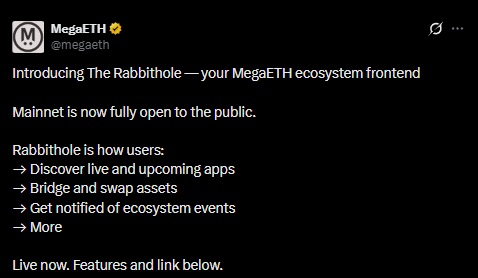
MegaETH launched its mainnet with more than 50 applications live from day one, according to the network’s public interface. The project introduced the network as a real-time blockchain, with a technical target of up to 50,000 transactions per second and 10-millisecond block times.
The system design centers on latency as an operational variable. To achieve that goal, MegaETH developed a proprietary architecture called SALT, short for Small Authentication Large Trie. The system keeps critical data in memory and avoids delays associated with traditional storage access. The network uses Ethereum for settlement and security, while separating the execution layer to push performance beyond the limits of conventional architectures.
MegaETH was founded in 2022. In June 2024, the project raised $20 million in a seed round led by Dragonfly Capital, with participation from Vitalik Buterin and Joseph Lubin. Before the mainnet launch, the network operated a testnet and, in January, executed a global stress test designed to process 11 billion transactions over seven consecutive days, with the goal of validating performance under sustained load.
The mainnet launch follows a public token sale held in October 2025. That round raised $1.39 billion in commitments and recorded an oversubscription of 27.8x. Unlike other projects, MegaETH decoupled the network launch from the generation event of its native MEGA token.
MegaETH Will Wait for Specific Conditions to Launch the MEGA Token
The MEGA token will be issued seven days after at least one of three performance indicators defined by the team is met. The KPIs include reaching an average circulating supply of $500 million in the USDM stablecoin over a 30-day period, having 10 MegaMafia applications active on mainnet, or recording three applications that generate more than $50,000 in daily fees for 30 consecutive days.

The token’s economic structure is based on two main mechanisms. The first is Proximity Markets, where users lock MEGA to access colocated sequencers and reduce latency. The second is a buyback program that uses the entirety of the yield generated by the USDM stablecoin to purchase MEGA and remove it from circulation.
The application ecosystem includes teams formed within the internal MegaMafia accelerator. According to the project, those teams have raised more than $70 million in venture capital from firms such as Franklin Templeton, Robot Ventures, Maven11, and Figment Capital