

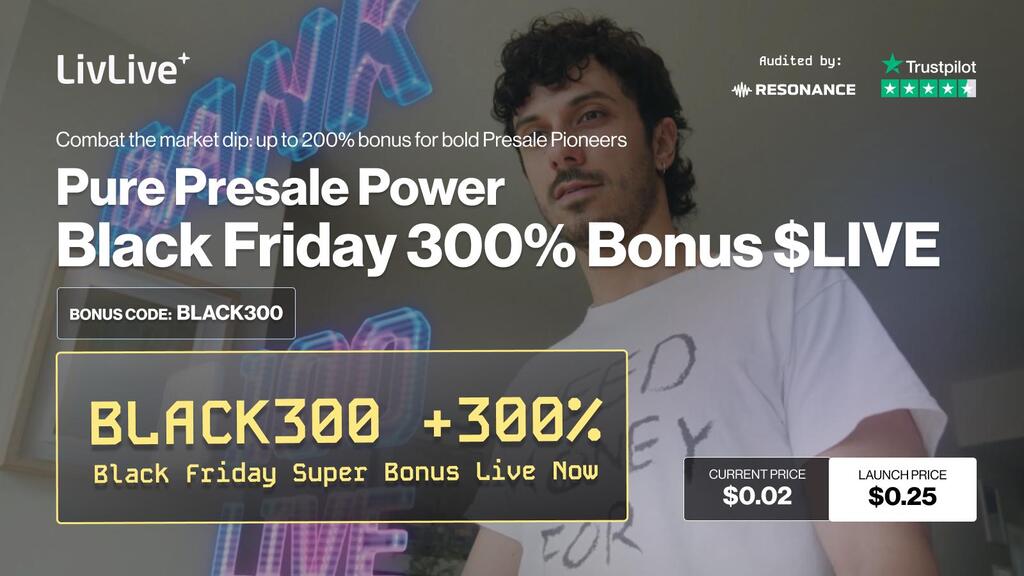
Speculation around early-stage token sales often centers on timing and future expectations. BlockDAG is described by its team as approaching a final sale stage, while a newer project, LivLive ($LIVE), is marketing an early-stage fundraising round. Both present themselves as technology-focused efforts, but they are at different points in their fundraising timelines. LivLive is described as being in “Stage 1” with a listed token price of $0.02, according to project materials, with more details available on the project website (for reference): LivLive.
LivLive says it is building a system that rewards real-world engagement. The project reports raising more than $2.18M with 350+ early participants, and describes an ecosystem that includes wearable hardware, AR quests, and gamified features. These figures and product descriptions are not independently verified in this article.
LivLive ($LIVE): AR-focused token sale and engagement model
LivLive has been promoted as a fast-growing token sale in 2025. The project describes a staged pricing model and says users may be able to receive tokens in exchange for “verified” real-world actions, though how this operates in practice depends on implementation and adoption.
According to the project, activities such as walking, scanning, attending events, or leaving on-chain reviews can be recorded and may result in $LIVE tokens. LivLive also says it uses a wearable wristband and an AR-driven app to verify activity before issuing rewards, with the stated goal of limiting fraudulent participation.

Project-promoted “Black Friday” bonus (as described by LivLive)
LivLive says it has extended a marketing code (BLACK300) that it describes as providing a 300% extra token bonus. Promotional incentives like these are set by the project and may change; they should not be interpreted as an indicator of future returns or market performance.
Project materials also reference future stage pricing and a potential “launch price.” These are forward-looking statements and may not reflect how a token ultimately trades, if it becomes tradable at all.
The project has compared its early fundraising dynamics to other token sales. Such comparisons are not predictive, and different projects can face substantially different market conditions, liquidity, and execution risk.
How the engagement and verification system is described
LivLive says its “Proof-of-Presence” wearable uses GPS and AR-based checks to confirm real-world activity and to allocate tokens and XP. As with similar systems, the effectiveness of these claims depends on verification methods, user adoption, and the project’s operational capacity.
The project also describes a closed-loop loyalty economy that connects brands, businesses, and users through verified engagement (for example, reviews, check-ins, and purchases). These mechanisms and outcomes are described by the project and are not independently verified here.
A recent update attributed to the project’s CMO referenced expansion plans across Japan, Korea, and Southeast Asia, alongside advertiser partnerships and wearable integrations expected to increase network scale by early 2026. As with any roadmap, timelines and outcomes can change.
LivLive also mentions a referral program, commissions, and prize-related promotions in its marketing materials. These incentives are promotional in nature and may be subject to eligibility rules and change over time.
Participation details (as described by the project)
LivLive’s materials describe participation via a compatible crypto wallet and payment methods such as ETH, USDT, or card payments, depending on availability and jurisdiction. Readers should review the project’s terms, technical risks, and any regulatory considerations before deciding whether to participate.
BlockDAG: Project overview and fundraising stage
BlockDAG (BDAG) has been promoted for using a Directed Acyclic Graph (DAG) architecture, which the project says allows multiple blocks to be confirmed simultaneously. The project also describes a hybrid approach combining DAG concepts with Proof-of-Work, with a stated goal of improving throughput compared with some traditional blockchain designs.
BlockDAG is described as entering a final stage of its token sale, following a large 2025 fundraising campaign. While supporters point to technical differentiation and community traction, later-stage fundraising typically comes with different pricing, liquidity expectations, and risk profiles than earlier stages.
Some market commentary has suggested that attention can shift from one token sale to another over time, but such narratives are speculative and do not establish likely outcomes for either project.
What to watch heading into 2026
BlockDAG and LivLive present different narratives: one emphasizes network architecture and a later-stage fundraising phase, while the other emphasizes AR and wearable-driven engagement in an earlier-stage token sale. For readers evaluating either project, relevant considerations typically include product delivery, transparency, token distribution, market liquidity, security, and regulatory risk.
LivLive’s reported fundraising figure ($2.18M), staged pricing, and promotional incentives may indicate marketing reach, but they do not establish market demand after any potential listing, and they do not reduce the underlying risks of early-stage crypto projects.
Any outlook for 2026 remains uncertain, and outcomes will depend on execution, broader market conditions, and whether users and partners adopt the products described.

For More Information:
Website: http://www.livlive.com
Telegram Chat: https://t.me/livliveapp
This article is for informational purposes only and does not constitute financial or investment advice. This outlet is not affiliated with the project mentioned. Readers should do their own research and consider the risks before participating in any token sale or using any related products.

