
Robert Kiyosaki has repeated a forecast of a historic collapse in stock and bond markets. The factors cited are verifiable: capital concentration around the artificial intelligence narrative, escalation of the conflict with Iran, sovereign debt levels without precedent in the modern historical series, and progressive liquidation of baby boom generation portfolios. The associated recommendation is also known: hold gold, silver, and Bitcoin instead of cash.
For the crypto sector, the disputed point is not the macroeconomic diagnosis. The disputed point is the classification of Bitcoin as a hedging instrument within an equity decline. Evidence accumulated during 2025 and 2026 contradicts that classification in most liquidity stress scenarios.
BIGGEST CRASH IN HISTORY has started.
In 2002 I released RICH DADS PROPHECY. This book was written to prepare people to profit and not be victims of the biggest stock and bond market crash in history…. a crash that was still coming.
In 2026, that crash started, in Europe…
— Robert Kiyosaki (@theRealKiyosaki) September 15, 2026
Correlation Is No Longer an Incidental Feature
During 2024, the correlation between Bitcoin and the S&P 500 averaged 0.29. In 2025, the figure rose to 0.50. The change does not respond to an editorial decision or to a market narrative. The change responds to the composition of the marginal shareholder.
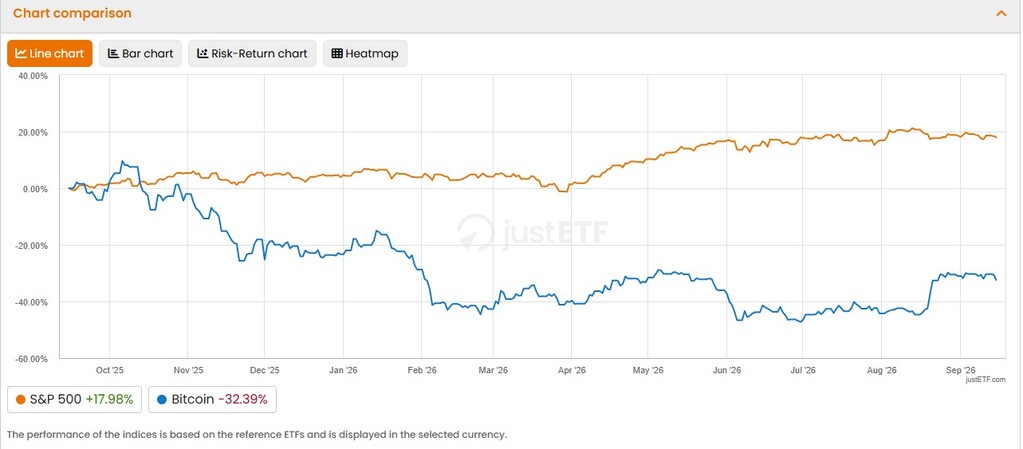
Entry of institutional investors and traditional retail through regulated vehicles shifted price formation from a base of native participants toward a base that manages Bitcoin as a position within a multi-asset portfolio.
The operational consequence is direct. An asset whose marginal demand comes from allocators rebalancing risk across asset classes behaves as a risk asset when those allocators reduce exposure.
The designation of store of value requires demand increasing during stress. Current ownership structure does not guarantee that behavior.
October 2025 as a Case Study
On October 10, 2025, a tariff announcement from the United States administration triggered the largest liquidation event recorded in crypto markets. The figure exceeded 19 billion dollars in forced position closures, with approximately 1.6 million traders affected.
Bitcoin had marked an all-time high above 126,000 dollars days earlier and declined to the 107,000 dollars area. Recovery afterward was partial, and the market operated with reduced depth for weeks.
The trigger was external and macroeconomic in nature, but the magnitude of the movement was explained by internal crypto market conditions: elevated leverage, markets operating 24 hours per day, absence of interruption mechanisms, and liquidity concentrated in few market makers.
A shock of a given magnitude in the S&P 500 produced a displacement several times larger in Bitcoin. The transfer function amplifies, not attenuates.
Contradictory Evidence and Limited Scope
Records exist pointing in the opposite direction. During the 2026 United States-Iran conflict, Bitcoin and Ethereum outperformed major equity indices and traditional safe-haven assets in March, according to data published by Binance Research. Sector analysts presented the episode as validation of the geopolitical resilience thesis.
The scope of that validation is limited. A geopolitical shock with limited impact on global funding conditions is not equivalent to a liquidity shock. The distinction is relevant because stock market collapses of historic magnitude operate through forced deleveraging, funding restrictions, and asset sales to cover margins in other positions. In a regime of that nature, the investor sells what can be liquidated, not what the investor wishes to keep.
An analysis published by Forbes in 2026 noted that the safe haven thesis for Bitcoin faced its greatest empirical challenge. The central argument: structural demand for gold comes from central bank purchases, a buyer without a functional equivalent in the digital asset market.
An economist cited in the same analysis argued that neither Bitcoin nor gold operates as a safe haven during systemic crisis episodes. The applicable conclusion is that Bitcoin behavior in crisis depends on the type of crisis, which constitutes an operational limitation, not a desirable property.
Recent Decorrelation and Idiosyncratic Regulatory Risk
In September 2026, the 260-day rolling correlation between Bitcoin and the S&P 500 declined to approximately minus 0.6, the lowest level since 2015. The 30-day correlation fell to 0.43 from 0.75 in a single session, in anticipation of the Federal Reserve decision.
The decorrelation process coincides with a sector-specific factor: lack of progress on the Clarity Act in the United States Senate.
Absence of a legislative market structure framework caused declines in Bitcoin and in crypto-linked equities on sessions where broad market responded to other variables.
The implication is that the sector maintains exposure to idiosyncratic regulatory shocks independent of the macroeconomic cycle and not hedgeable with traditional instruments.
Instability of the correlation coefficient constitutes a problem for portfolio construction. An asset whose correlation oscillates between 0.5 and minus 0.6 within one year does not offer a predictable contribution to portfolio risk.
The decorrelation observed in September 2026 does not invalidate behavior recorded in October 2025. The observation indicates that the correlation regime is unstable and that allocation must be sized assuming the worst regime, not the average.
Institutional adoption reached relevant figures: approximately 95 billion dollars in United States spot Bitcoin ETFs and more than 170 publicly listed companies with Bitcoin on balance sheet. The usual interpretation presents that base as a demand floor. The alternative interpretation is that the base introduces a transmission channel.
Institutional portfolios that can no longer use Treasuries as an effective equity hedge face constrained options. When bond-equity correlation remains positive, risk reduction must be executed through sales across all available asset classes.
Bitcoin, as part of those portfolios, is included in the deleveraging process. Institutional ownership does not eliminate forced selling. Institutional ownership incorporates forced selling into a systematic rebalancing mechanism.
A market operating continuously, without interruption mechanisms, with elevated aggregate leverage, and without access to a central bank discount window lacks the buffers that moderate declines in regulated equity markets. Absence of a lender of last resort for the sector implies that liquidation cascades stop through exhaustion of positions, not through intervention.
The design produces price paths with fat tails in the return distribution. For a risk manager, the implication is that expected maximum loss in a stress scenario must be estimated with more severe assumptions than instruments with containment mechanisms.
Implications for Portfolio Allocation
The operational conclusion for the sector is that Bitcoin must be sized as a high-beta position within the risk block, not as a substitute for gold or short-duration fixed income. Position size must be derived from tolerable drawdown in the worst observed correlation regime, not from the historical average.
Tactical liquidity fulfills a distinct function. Holding stablecoins or cash instruments allows execution of purchases during forced liquidation episodes, when seller supply does not respond to valuation.
The permanent safe haven narrative leads to the opposite position: full exposure during the decline and no purchasing capacity at the point of maximum price dispersion.