TL;DR:
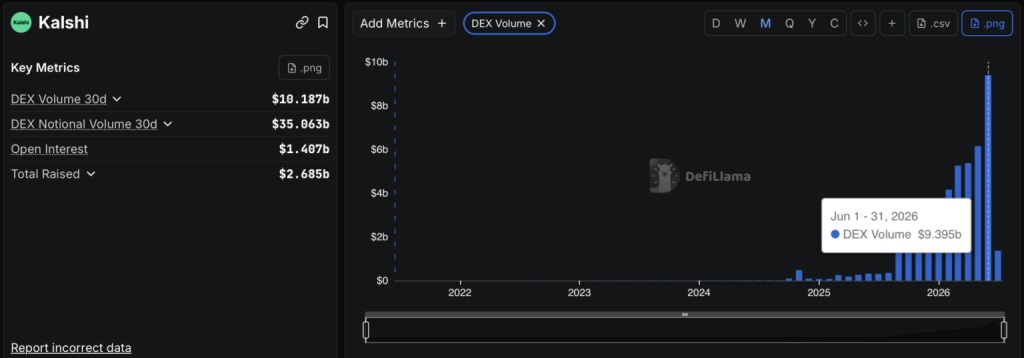
- Kalshi neared $10 billion in monthly volume during June, driven by markets tied to FIFA World Cup contracts.
- A Michigan judge blocked Kalshi from accepting wagers from state residents following a complaint by Attorney General Dana Nessel.
- The European Securities and Markets Authority warned that many prediction contracts could fall under existing binary options restrictions.
The prediction market Kalshi reached approximately $9.4 billion in monthly activity, according to data from DefiLlama, an exponential jump from the $5.3 billion recorded in May.
The catalyst was the demand generated by the FIFA World Cup, which kicked off on June 11 with a new format featuring 48 national teams. More teams meant more fixtures, more contract listings and tighter trading windows. The same DefiLlama data places notional volume near $35.06 billion and open interest around $1.41 billion, figures that indicate traders treated event contracts as active markets, not marginal bets.
Kalshi operates as a federally regulated event derivatives exchange, not as a sports betting house. That distinction attracted users already fluent in the language of pricing, and it also deepened a jurisdictional dispute that shows no signs of resolution anytime soon.
Crypto Federalism Doesn’t Exist: Kalshi Learns It in Court
Reuters reported that a Michigan judge barred Kalshi from accepting trades from state residents, following a complaint filed by Attorney General Dana Nessel, who characterized those markets as illegal gambling products under state law. Judge Rosemarie Aquilina went further and threatened daily fines tied to geolocation compliance.
The company argued that federal commodities law governs its listed contracts and that the Commodity Futures Trading Commission holds exclusive authority over event derivatives. Holland & Knight reported that a federal appeals court upheld this position in April, holding that the Commodity Exchange Act displaces state rules for certain sports contracts. However, other courts have ruled differently, and the conflict remains open.
The Digital Chamber filed an amicus curiae brief in favor of federal oversight, arguing that state-by-state enforcement could fragment derivatives markets. That position aligns with other firms seeking a single national regulatory framework.

Warning From the European Market
Last Friday, the European Securities and Markets Authority indicated that many prediction contracts could fall under the binary options restrictions already in force across the bloc, and that classification depends on the product’s characteristics, not on the contractual label. That warning weighs on any firm planning to launch cross-border products, as Europe appears inclined to apply investor protection rules first.
As long as World Cup fixtures sustain demand on Kalshi, the next indicator of the model’s health will be volume once the excitement fades. The next legal signal will come from pending state cases, before courts issue more definitive guidance.