TL;DR:
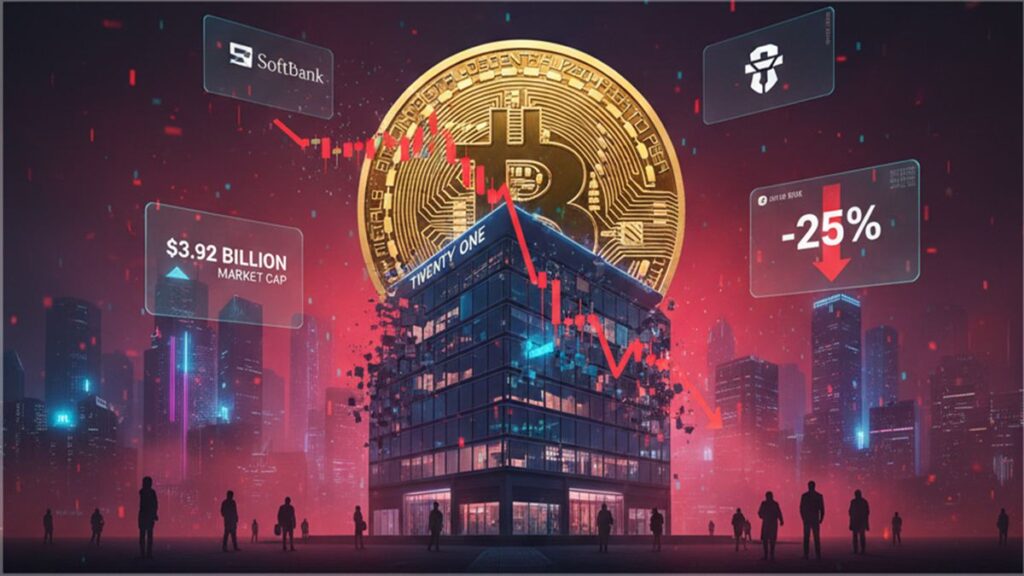
- Twenty One shares, led by Jack Mallers, have lost 25% of their value in the last month, mirroring the decline of its peers.
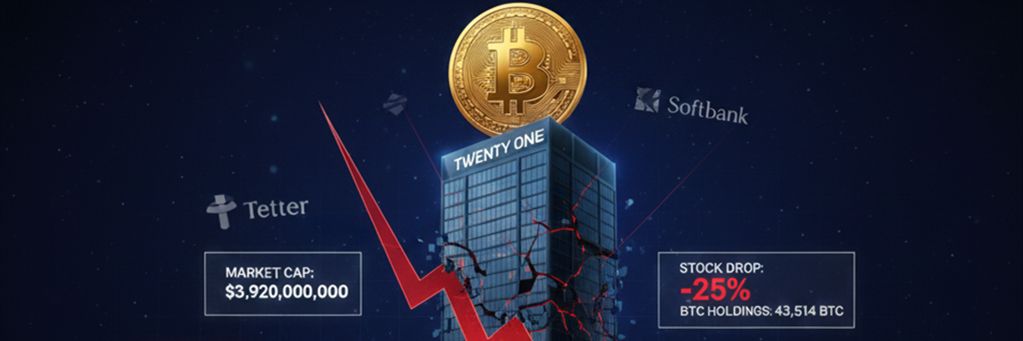
- Twenty One’s market capitalization is exactly equal to the value of its 43,514 BTC reserve ($3.92 billion).
- Investors are assigning zero value to the operational business lines or the backing of its billionaire investors, including Softbank and Tether.
Despite Twenty One CEO Jack Mallers’ insistence that his company is different from other Bitcoin reserve vehicles, its stock price tells an identical story to the rest of the sector. In November alone, Twenty One shares fell by 25% of their value, matching the decline seen in Michael Saylor’s MicroStrategy and other peers in the sector. Other companies like Strive Asset Management and Nakamoto have seen even deeper drops. This behavior suggests that the market, despite narratives of differentiation, treats Mallers’ company strictly as a passive BTC trust.
Investor distrust is highlighted by a stark financial metric: Twenty One owns exactly 43,514 BTC, with a current market value of $3.92 billion. This figure precisely matches the company’s current market capitalization. In other words, investors are valuing the company at its liquidation value (the total sum of its Bitcoin holdings), assigning a zero-dollar value to all of Mallers’ supposedly differentiated value propositions.
This includes the strategic value of its alliances with high-profile billionaire partners like Tether, Softbank, and Cantor Fitzgerald, whose presence has failed to convince the market to pay any premium over its holdings.
Zero Confidence in the Promise of Cash Flow
The CEO vaguely claimed that Twenty One is not simply a passive balance sheet trade but a “Bitcoin-native” operating business with the explicit goal of increasing “BTC per share” through multiple business lines.
Mallers stated, “We’re bringing a lot of BTC products to market with the intent to have cash flow.” However, the operational reality so far does not support the narrative: the company has not reported any cash flow in its quarterly earnings.
The disconnect is painful for investors. Twenty One’s stock has underperformed the S&P 500 by about 500 basis points year-to-date, even when considering the period before its SPAC merger. Worse yet, the vast majority of retail investors have lost money.
Since the merger deal was announced, the stock has spent only a single trading day at prices lower than today’s price. The cumulative decline from its peak in May reaches 80%, confirming that the market demands tangible operating results that Twenty One has yet to deliver.