TL;DR
- Institutional traders like Wintermute and Dragonfly Capital secured multimillion-dollar profits in December.
- Gains were highly concentrated among a small group of repeat professional funds.
- On-chain data shows tactical selling for risk reduction, not panic-driven dumping.
Institutional traders closed out December by locking in millions in realized gains, even as broader crypto markets faced persistent volatility and weakening sentiment. According to new on-chain data from Nansen, top-performing funds like Wintermute and Dragonfly Capital executed a disciplined round of profit-taking and risk reduction, indicating strategic management rather than long-term bearish positioning.
Nansen’s analysis shows that profits were highly concentrated among a small group of repeat institutional funds, reinforcing the growing divide between professional trading operations and retail investors still struggling through the downturn.
Institutional Profit Concentration and Trading Discipline
Data from Nansen reveals that Wintermute emerged as the most profitable fund in December, generating around $3.17 million in realized gains. Close behind, Dragonfly Capital posted multiple profit clusters across its wallets, totaling $1.9 million, $1.0 million, and $990,000, respectively.
Other active players such as IOSG and Longling Capital also ranked among the month’s top performers, maintaining consistent profitability across networks. According to Nansen’s 30-day dataset, additional institutional names including Arrington, Pantera, and Polychain displayed varied but positive returns across five blockchains.
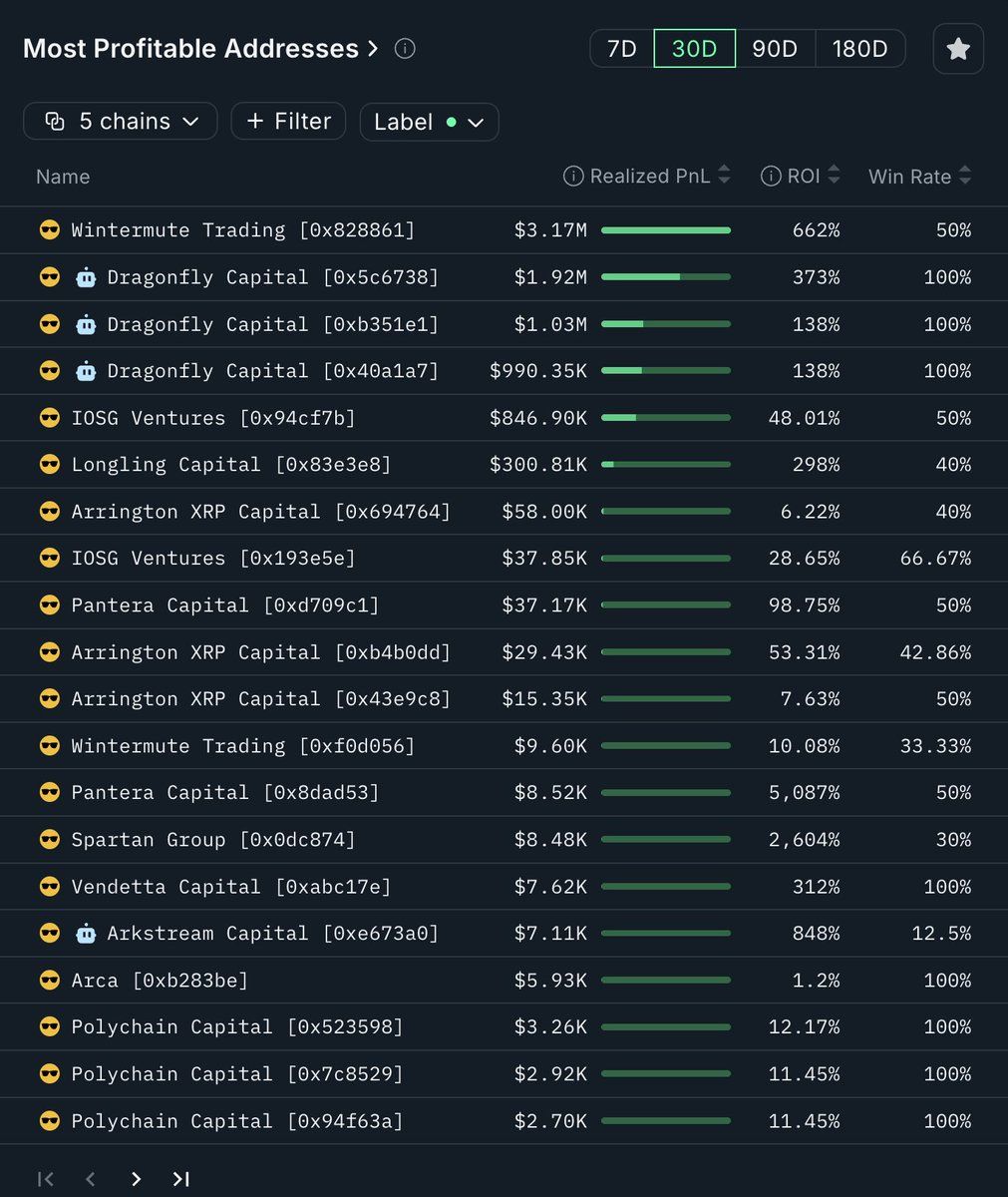
The overall pattern underscores how institutional funds — equipped with advanced trading infrastructure and multi-chain monitoring tools — exploited short-term volatility while most retail participants absorbed losses.
“Profits are concentrated among a small group of repeat funds, not one-off wallets,” Nansen noted, emphasizing that steady trade execution separated winners from those caught in the December pullback.
Dragonfly Capital’s diversified strategy across wallets provided risk dispersion while allowing flexibility to capture gains across multiple assets. Meanwhile, Wintermute’s liquidity provision model enabled the firm to profit directly from volatility, consolidating its role as one of the most active market makers during the month’s turbulence.
On-Chain Data Points to Aggressive Profit-Taking
Nansen’s tracking indicates that by the final week of December, several of these profitable funds shifted toward selling. On December 26, QCP Capital transferred 199.99 ETH (worth approximately $595,929) to Binance — a move often linked to asset liquidation or short-term rebalancing.
Similarly, Wintermute reduced its Bitcoin and Ethereum exposure after early-month accumulation. While speculation circulated online about heavy dumping, the data shows a more structured unwind consistent with measured risk management rather than panic selling.
🚨 BREAKING:
WINTERMUTE ACCUMULATED MILLIONS WORTH OF $BTC AND $ETH RIGHT BEFORE CHRISTMAS DUMP
THEY DUMPED $125M+ OF $BTC IN A MINUTE, DROPPING IT TO $24K
THIS IS PURE CHRISTMAS MANIPULATION!! https://t.co/hSbWI1Bl2R pic.twitter.com/MmQv1nBZql
— ᴛʀᴀᴄᴇʀ (@DeFiTracer) December 25, 2025
Dragonfly Capital, on the other hand, executed a partial Mantle exit, selling $6.95 million worth of MNT tokens but still holding 9.15 million MNT, valued near $10.76 million. The position adjustment reflects a controlled scaling-down approach rather than a full withdrawal.
.@dragonfly_xyz (Dragonfly Capital) continues depositing $MNT to @Bybit_Official.
Over the past 7 days, they've already sent 6,000,000 $MNT (~$6.95M USD)
They still hold 9.15M tokens across multiple wallets, worth around $10.76M. pic.twitter.com/3M2s5se9l6
— Nansen 🧭 (@nansen_ai) December 21, 2025
Collectively, the selling activity represents a two-part institutional strategy: capitalize on volatility-driven profits, then de-risk as conditions shift. For most professional funds, such year-end moves also align with portfolio rebalancing, capital preservation, and preparation for early 2026 allocations.
While these sales may exert temporary pressure on crypto prices, they signal discipline and tactical repositioning, not an abandonment of exposure. In an environment defined by uncertainty, measured de-risking stands as a hallmark of institutional maturity — and may ultimately support more stable market structure as 2026 begins.