
Illinois Crypto Tax Faces Legal Challenge From Industry Leaders

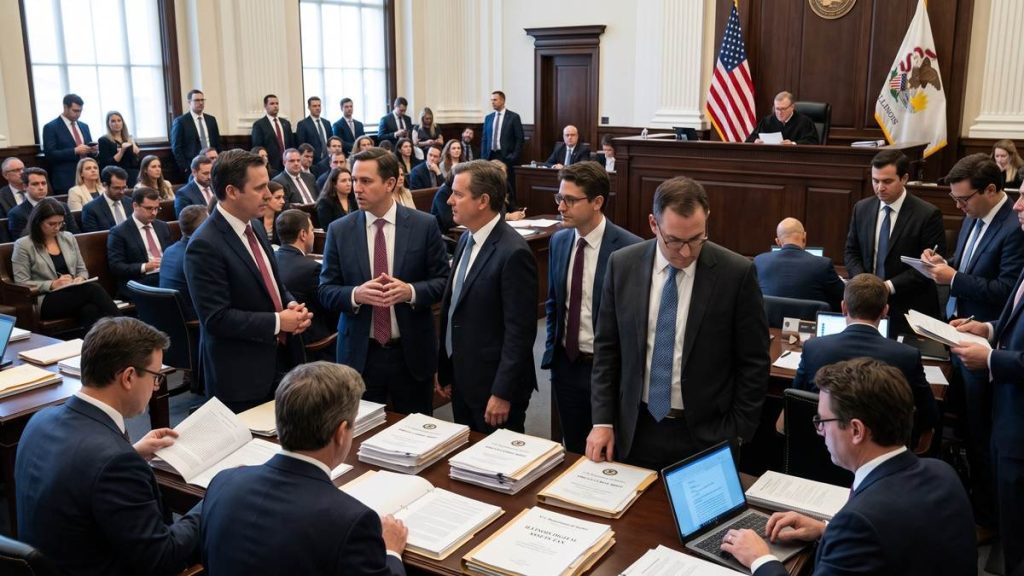
Table of Contents
TL;DR:
- The Illinois Digital Asset Tax Act establishes a 0.2% levy on the total value of every trade, transfer, or custody transaction executed through a broker.
- The U.S. Department of Justice, the Chamber of Commerce, SIFMA, and a coalition led by a16z and Uniswap filed court briefs in November 2026 opposing the rule.
- The state of Illinois agreed in October 2026 to pause the implementation of the tax until July 1, 2027, while litigation proceeds in state courts.
A coalition comprising the U.S. Department of Justice, traditional banking associations, and firms from the decentralized sector filed several court briefs in November 2026 to block the Illinois crypto tax. The filings support the lawsuit brought in August by the Crypto Council for Innovation and the Blockchain Association seeking to permanently strike down the state’s Digital Asset Tax Act.
The state legislation imposes a 0.2% levy on the full value of a digital asset every time an Illinois resident trades, transfers, or stores it through a broker. According to the statutory text, the fee applies even in the absence of a sale, a capital gain, or a change in ownership of the funds.
Various critical sectors documented that the state of Illinois does not apply an equivalent tax burden on cash, gold, corporate stocks, or any other class of financial asset. A market report indicates that no other state jurisdiction within the United States currently maintains a tax structure with similar characteristics in force.
On November 6, 2026, the U.S. Department of Justice filed a formal statement of interest before the state court hearing the case. In that document, the federal agency argued that the measure undermines national policy and the country’s leadership in digital assets, characterizing the rule as vague and discriminatory for singling out cryptocurrencies for isolated treatment.
In parallel, the U.S. Chamber of Commerce and the Securities Industry and Financial Markets Association (SIFMA) submitted an amicus curiae brief on behalf of hundreds of broker-dealers, banks, and asset managers. Both organizations warned in their filing that the scope of the law extends beyond native cryptocurrency platforms and directly impacts traditional banks, custodians, and financial advisors offering digital asset-based products.

The Decentralized Finance Front and the Technical Scope of the Law
A second amicus curiae brief was filed on November 11, 2026, by an alliance of companies and investors from the decentralized finance (DeFi) and venture capital ecosystem. The filing was spearheaded by the DeFi Education Fund, Andreessen Horowitz (a16z), Paradigm, and Uniswap, with the backing of Aave Labs, Chainlink Labs, Solana Policy Institute, Phantom, Jito Labs, Multicoin Capital, and Stand With Crypto.
The document submitted by the technology firms contends that the definitions included in the state statute lack technical precision. According to the DeFi coalition’s brief, the current wording of the rule could extend tax obligations to software developers and decentralized protocols that do not custody client funds, lack mechanisms to identify users, and have no way of verifying the geographic location where a transaction takes place.
Data entered into the court record by this group estimates that approximately 2.64 million Illinois residents own digital assets. This figure places the state fifth nationwide in terms of population volume holding cryptocurrencies, according to the statistics cited in the legal filing.
For their part, the lead plaintiffs reiterated their stance as the proceedings advance in state court. “This tax is unclear, discriminatory, unconstitutional, and harmful to the future of finance,” stated Ji Hun Kim, CEO of the Crypto Council for Innovation, and Ashok Pinto, an executive at the Blockchain Association, in a joint statement.
The current litigation formally originated in August 2026 following initial legal actions against the legislation passed in June of the same year. Faced with the onset of the challenges, Illinois authorities agreed in October 2026 to suspend the effective date of the levy, originally scheduled for January 2027. The next procedural milestone on the regulatory calendar was set for July 1, 2027, the new stipulated date for the eventual enforcement of the tax if the state court does not order its permanent injunction prior to that deadline.

a16z, Uniswap and DeFi Education Fund Take on Illinois Over Crypto Tax Rules
TL;DR: Joint regulatory petition: Andreessen Horowitz (a16z), Uniswap Labs, and DeFi Education Fund submitted formal comments on October 30, 2026, against the Illinois Department of

Illinois Delays Crypto Tax for Six Months as Industry Battles the State in Court
TL;DR Illinois has agreed to delay its 0.2% digital asset tax for six months, moving implementation to July 1, 2027, subject to court approval. The

Illinois Extends 0.2% Crypto Tax to Stablecoins and DeFi
TL;DR: Illinois’ draft rules would apply the state’s 0.2% Digital Asset Tax to stablecoins, while NFTs would remain outside the proposed scope. DeFi transactions would

Digital Chamber Challenges Illinois Over Controversial Crypto Tax Law
TL;DR: The Digital Chamber filed a formal lawsuit in Sangamon County, Illinois, to block the Digital Asset Tax Act. The legislation enacted in June applies

Kalshi Sues Illinois Over New State Tax Targeting Sports Prediction Markets
TL;DR: Federal lawsuit: Kalshi filed a lawsuit in the U.S. District Court for the Northern District of Illinois following the passage of bill SB 3019.

Alchemy Pay gets Illinois license, reaches 18 states
Alchemy Pay that it secured a Money Transmitter License in Illinois, expanding its U.S. regulatory coverage to 18 states. The approval gives the company a