TL;DR
- Vitalik Buterin warned that prediction markets are focused on short-term speculation, centered on cryptocurrencies and sports.
- He classified users into three categories: uninformed traders, information buyers, and hedgers, noting that activity depends primarily on the first group.
- He proposed shifting markets toward risk hedging and financial stability through price indices of goods and services, personalized baskets, and contracts in alternative assets.
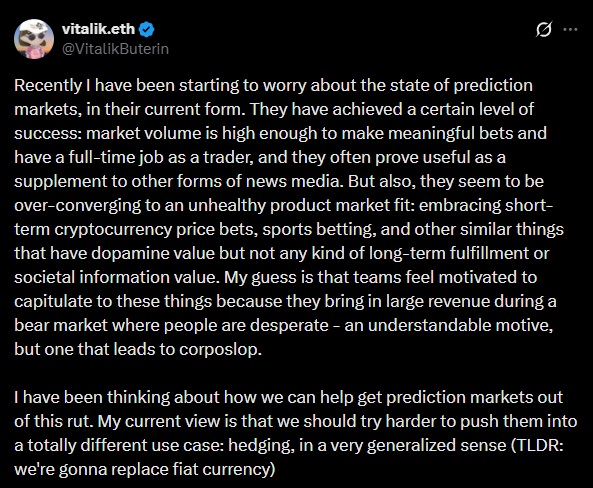
Vitalik Buterin highlighted the recent evolution of prediction markets and stated that their dominant use has shifted toward short-term speculation. He noted that current volume allows professional trading and that markets provide informational signals, but he affirmed that much of the activity is concentrated on bets on cryptocurrency prices and sporting events.
Vitalik explained that this dynamic responds to economic incentives. According to him, platforms prioritize high-engagement products because they generate revenue during bear markets. This behavior directs offerings toward high-engagement formats instead of information tools or financial management.
Buterin classified users into three categories: uninformed traders, information buyers, and hedgers. He noted that the system relies mainly on the first group, whose mistakes fund market activity. He stated that this structure incentivizes attracting participants with incorrect opinions and designing environments that encourage that behavior.
He proposed shifting primary usage toward risk hedging. He explained that an investor exposed to an event can reduce uncertainty by taking an opposite position within the market. In his example, a $10 bet on an adverse outcome reduces the variability of the total return and improves expected utility by $0.58.
Buterin Proposes Analyzing Expenses and Seeking Hedging
His proposal also addresses financial stability. Buterin suggested using prediction markets to hedge future expenses through price indices of goods and services. Each user could hold assets for growth while simultaneously holding shares representing several days of expected consumption.

He also described integration with local language models capable of analyzing spending patterns and constructing personalized hedging baskets. In this framework, markets would operate as instruments of stability rather than speculative tools.
According to Buterin, contracts should be denominated in assets that users want to hold, such as cryptocurrencies or tokenized securities. His proposed goal is a system where both sides obtain direct economic utility without relying on short-term betting