


Some market participants look beyond large-cap networks for early-stage tokens that may be marketed as high-upside opportunities. In this context, top crypto presales for long term is used as a label in some promotional materials to describe fundraising offerings. This article reviews Ethereum’s recent pricing context and summarizes project-reported information about BullZilla ($BZIL), while noting that outcomes are uncertain and risks can be significant.
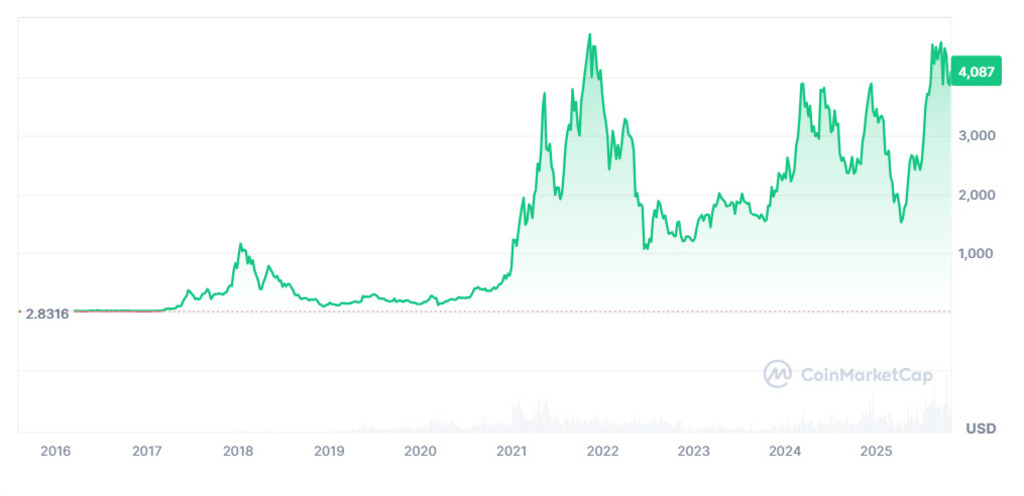
Ethereum’s role in DeFi and smart contracts continues to influence how new tokens are launched and marketed. Separately, BullZilla ($BZIL) is being promoted through a staged token fundraising event and related incentives, according to the project’s public materials. The two assets differ substantially in size, maturity, liquidity, and risk profile, and should not be treated as comparable.
Market sentiment can shift quickly, and crypto assets can be highly volatile.
Ethereum ($ETH): Network activity and recent price context
Ethereum remains one of the largest smart-contract networks by usage and market value. The figures below are presented as market snapshots and may change rapidly: the article references ETH trading around $4,098.84, a market capitalization near $494.55 billion, and daily volume around $37.84 billion, alongside short-term percentage moves. These numbers should be treated as informational rather than predictive.
On network development, Ethereum Foundation materials describe ongoing work on scalability upgrades (including proto-danksharding), which are intended to improve data availability and could affect costs for some users, though real-world impacts can differ from targets. Separately, third-party research outlets (including Messari) have reported estimates for the amount of ETH staked and ranges of staking yields; those estimates can vary by methodology, validator performance, fees, and network conditions. Price forecasts cited by market commentators (including ranges sometimes discussed in media) are speculative and not guarantees.
While Ethereum is widely followed and comparatively liquid, it can still experience sharp drawdowns. Claims that smaller, earlier-stage token offerings necessarily provide “higher returns” are not reliable; many such assets fail, are illiquid, or face security and execution risks. Readers should consider the different risk characteristics before drawing conclusions from percentage-based comparisons.
Frequently Asked Questions About Ethereum
How does Ethereum maintain long-term relevance in blockchain markets?
Ethereum’s relevance is commonly attributed to ongoing protocol upgrades, broad developer activity, and significant liquidity across DeFi and other on-chain applications. However, competition from other networks and changing regulation can also affect adoption.
What is Ethereum’s six-month price outlook based on current fundamentals?
No six-month outlook is certain. Analysts and trading desks publish a wide range of scenarios based on variables such as network usage, macro conditions, and potential ETF flows, but these are opinions rather than reliable predictions.
BullZilla ($BZIL): Project-reported fundraising event and features
BullZilla is being marketed as an ERC-20 token with a staged fundraising event. In promotional materials, the project describes multiple “stages” and a pricing schedule that may change over time. The project has also published figures about tokens sold, funds raised, and holder counts; these claims have not been independently verified in this article.
According to the project’s descriptions, BullZilla includes features such as a referral program and a staking mechanism, and it also references supply-reduction (“burn”) events as part of its tokenomics narrative. Any reward rates, burns, or “deflationary” effects described by a project are not guarantees of value appreciation, and participation can involve smart-contract risk, liquidity risk, and market risk.
Marketing materials for early-stage token sales sometimes include hypothetical return scenarios and “listing price” comparisons. Such examples are inherently speculative and can be misleading, particularly because future listings, liquidity, and pricing depend on factors outside any project’s control. Readers should treat these materials as promotional, not as forecasts.
About hypothetical return examples in token-sale marketing
If a project provides calculators, ROI projections, or “$X becomes $Y” illustrations, those are scenarios rather than evidence of expected performance. Outcomes can include partial loss or total loss, and tokens may remain illiquid or unlisted.
Frequently Asked Questions About the BullZilla fundraising event
1. Why is BullZilla described as a “top” long-term token sale in some materials?
That characterization is promotional language used in some project marketing. It may refer to claimed tokenomics features (such as burns), community-building efforts, or incentive programs, but none of these elements ensures long-term performance.
2. How does the Roarblood Vault work, according to the project?
Project materials describe the Roarblood Vault as a referral-based incentive mechanism. Referral programs can create conflicts of interest and can encourage aggressive marketing; readers should assess the terms and risks carefully.
3. What does the project say about token allocation?
The project has published a token allocation breakdown covering categories such as a token sale, staking/community incentives, team allocation, and burns. Allocation claims should be verified against on-chain data and audited documentation where available, and readers should consider vesting schedules and concentration risks.
Summary

Conclusion
Ethereum’s scale, liquidity, and long operating history make it structurally different from early-stage fundraising projects. BullZilla, as described in project materials, is positioned around a narrative-driven meme token, staged pricing, and incentive mechanisms such as staking and referrals. These are project claims and marketing features rather than evidence of future performance.
Anyone evaluating early-stage tokens should consider disclosure quality, smart-contract and custody risks, liquidity constraints, and regulatory uncertainty. Publicly available project websites and social accounts can provide additional context, but readers should independently verify claims and avoid relying on promotional projections.
For reference:
Follow BZIL on X (Formerly Twitter)
This article contains information about a cryptocurrency token fundraising event. This outlet is not affiliated with the project mentioned. As with any initiative within the crypto ecosystem, readers should do their own research and consider relevant risks. This article is for informational purposes only and does not constitute financial or investment advice.

