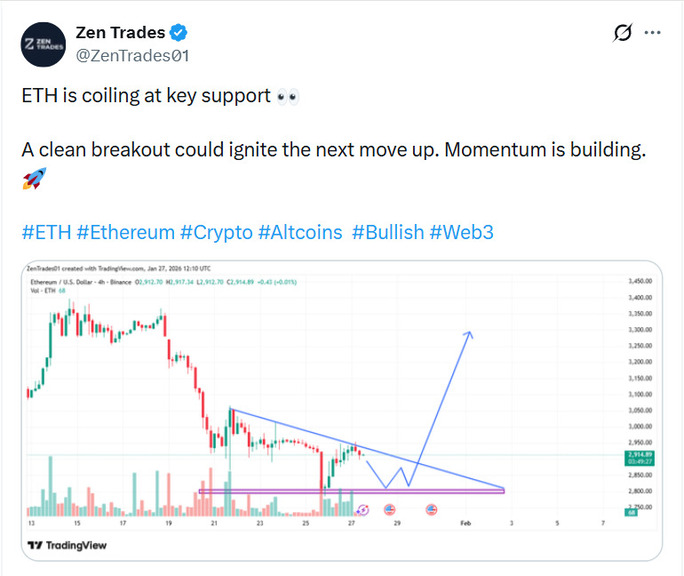
Ethereum began 2026 with continued stability following the Pectra upgrade, trading near $4,250 and recording moderate weekly gains. Increased rollup adoption and restaking activity continue to reinforce Ethereum’s role within the on-chain economy.
Alongside this, Zero Knowledge Proof (ZKP) has gained attention for addressing a structural issue within artificial intelligence development. Rather than focusing solely on software advancement, ZKP examines how data and compute resources concentrate over time and introduces a privacy-first framework designed to decentralize access. This broader infrastructure-oriented approach has positioned ZKP within discussions around emerging digital data networks.
Ethereum’s Market Structure After the Pectra Upgrade
The Pectra upgrade introduced several efficiency-focused improvements to Ethereum’s protocol. EIP-7702 enabled features such as batched transactions and gas sponsorships, EIP-7251 reduced validator workload, and EIP-4844 expanded blob capacity, contributing to lower rollup fees and improved scalability.
Recent network indicators include:
-
Price: Approximately $4,250 with consistent trading activity
-
Market capitalization: Around $1.2 trillion
-
RSI: Near 62, suggesting balanced momentum
-
MACD: Indicating a developing upward trend
-
Exchange supply: Approximately 18 million ETH, near multi-year lows
-
Staked ETH: Roughly 32.5 percent of total supply

Together, these metrics suggest Ethereum’s performance is supported by underlying network participation. Reduced exchange balances and higher staking participation continue to limit circulating supply, while blob fee dynamics help sustain validator incentives.
Layer-2 Expansion and On-Chain Usage Trends
A significant portion of Ethereum’s current activity is taking place across Layer-2 networks, which are increasingly responsible for transaction throughput and application usage.
Key Layer-2 indicators include:
-
Optimism Superchain: Approximately 100 transactions per second
-
Arbitrum BoLD: Around 1.2 million transactions per day
-
Total Layer-2 TVL: Approximately $55 billion
These figures reflect sustained application-level usage rather than speculative activity alone. The continued expansion of Layer-2 ecosystems highlights Ethereum’s evolving role as a settlement layer supporting scalable on-chain infrastructure.
ZKP’s Approach to Privacy-Preserving AI and Data Markets
ZKP approaches artificial intelligence development through the lens of data access and verification. Its framework focuses on enabling encrypted datasets to be verified and utilized without direct disclosure, allowing participants to confirm relevance and integrity before engaging in transactions.
Within ZKP’s design:
-
Data remains encrypted throughout the process
-
Computation is performed on private inputs
-
Outputs are validated using cryptographic proofs
This model seeks to broaden participation in AI development by reducing reliance on centralized data custodians. By maintaining privacy and ownership, ZKP aims to create a more accessible and transparent data marketplace for developers, researchers, and organizations.
Why Decentralized Data Markets Are Gaining Attention
Concentrated control over data resources can limit competition and slow innovation. ZKP’s framework introduces portability and verifiability without requiring direct data exposure, enabling participants to engage without relinquishing control.
The project reports over $100 million in self-funded development and a $17 million Proof Pods hardware layer, supporting encrypted computation and verifiable outcomes. By operating at the data access layer, ZKP positions itself within a foundational segment of the AI infrastructure stack, addressing challenges related to trust, ownership, and access.
Conclusion
Ethereum’s post-Pectra performance illustrates how protocol upgrades, Layer-2 adoption, and staking dynamics can contribute to long-term network resilience. With continued on-chain activity and infrastructure expansion, Ethereum remains a central component of the current blockchain ecosystem.
ZKP, meanwhile, addresses a different but increasingly relevant challenge: enabling AI development without centralized data control. By facilitating privacy-preserving data verification and computation, it introduces an alternative framework for how data-driven systems may evolve. Together, these projects highlight distinct approaches to infrastructure development within the broader digital economy.

Explore Zero Knowledge Proof:
Website: https://zkp.com/
Buy: https://buy.zkp.com
Telegram: https://t.me/ZKPofficial
X: https://x.com/ZKPofficial
FAQs
1. What changes did the Pectra upgrade introduce for Ethereum?
It added account abstraction features, reduced validator overhead, and expanded blob throughput, contributing to improved scalability and lower rollup fees.
2. What does ZKP mean by AI centralization?
It refers to the concentration of data and compute resources within a limited number of entities, which can restrict broader participation in AI development.
3. How does ZKP support decentralized data markets?
By enabling encrypted data to be verified and accessed through zero-knowledge proofs without revealing the underlying information.
This article contains information about a cryptocurrency presale. Crypto Economy is not associated with the project. As with any initiative within the crypto ecosystem, we encourage users to do their own research before participating, carefully considering both the potential and the risks involved. This content is for informational purposes only and does not constitute investment advice.