TL;DR
- Ethereum activated the second phase of the BPO hard fork and raised the blob limit from 15 to 21 per block, increasing the network’s data storage capacity.
- Each block can now handle up to 2.6 MB in 128 KB blobs, allowing Layer 2 networks to publish more aggregated data without competing with regular transactions.
- Raising the blob target from 10 to 14 expands network elasticity, absorbs activity spikes, and eases pressure on mainnet gas fees.
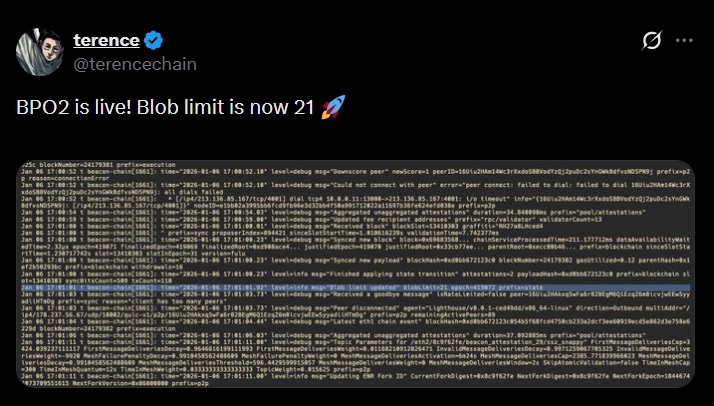
Ethereum activated the second phase of the BPO hard fork and increased the per-block blob limit from 15 to 21. The change is already live in production and delivers a concrete increase in the network’s data capacity, with a direct impact on Layer 2 solutions, fees, and mainnet operational stability.
Each blob can store 128 KB. Under the new parameter, each block supports up to 2,688 KB, roughly 2.6 MB of temporary data. This space is used primarily to publish aggregated information from Layer 2 networks, which process transactions off the base layer and then anchor them to the mainnet. By allowing more blobs per block, Ethereum expands the data throughput that L2s can submit without competing for space with regular transactions.
Ethereum Also Raised the Blob Target
Ethereum also raised the blob target from 10 to 14. This target defines the level of usage the network aims to sustain on a regular basis. The result is greater elasticity: more room to absorb activity spikes without abruptly pushing up gas fees.
The impact on fees is also central. When demand rises, blobs allow large volumes of data to move outside the traditional block space. This reduces congestion and smooths gas fee increases. For Layer 2 developers, this improves cost predictability and makes it possible to scale applications without affecting the end user.
The increase in capacity requires nodes with strong connectivity and sufficient storage. That is why developers are moving forward gradually. The goal is to improve performance without sacrificing security or decentralization. The BPO hard fork fits into that logic: higher parameters, but under control.

2026 Roadmap: Higher Gas Limit and Parallel Processing
This upgrade is only one part of the roadmap for 2026. Ethereum is evaluating raising the gas limit from the current 60 million to 80 million, which would allow more operations per block. Further ahead, the plan points to the Glamsterdam hard fork, which targets a gas limit of up to 200 million and will enable large-scale parallel processing.
That leap will rely on Block Access Lists, defined in EIP-7928. The goal is to allow multiple transactions to execute at the same time instead of sequentially. With that architecture, Ethereum aims to prepare its base layer for much higher demand, while maintaining control over costs and performance