


How far can Ethereum extend its role in an increasingly fragmented multi-chain environment? Various third-party forecasts publish estimates for ETH through 2026, but outcomes remain uncertain and depend on factors such as adoption, network activity, regulation, and broader market conditions. As decentralized applications scale and financial protocols push for greater interoperability, Ethereum is expected to remain an important part of multi-chain architecture.

Simultaneously, emerging Web3 projects such as Qubetics say they are developing interoperability tools aimed at reducing cross-network complexity and improving practical blockchain use. Separate from any single project’s claims, Ethereum’s future price will be influenced by a range of technical and macroeconomic variables, and published price targets should be treated as speculative.
Ethereum Price Prediction 2026: What the Numbers Reveal
Some public forecast sites publish ETH estimates for 2026, typically presented as ranges rather than certainties. One set of aggregated figures cited in market commentary suggests a minimum of $8,232.18, an average of $8,477.15, and a high of $10,283.97 for 2026. These figures are not guarantees and may change significantly as new information emerges.
Monthly breakdowns published by forecast models can vary widely. For example, some projections list average price estimates such as $5,106.70 (May) and $5,120.78 (June), and suggest higher ranges toward the end of the year. As with all model-based forecasts, these figures are sensitive to assumptions and should not be read as predictions of future performance.
Price Momentum and Utility Consolidation
Ethereum’s longer-term outlook is often discussed in connection with its use in decentralized finance and tokenization, as well as developer activity around smart contracts. Adoption of Layer 2 networks such as Optimism and Arbitrum has also been part of the broader conversation about scalability and fees.
A frequently cited technical factor is Ethereum’s role as a settlement layer for decentralized exchanges and lending protocols. Continued development in scaling, account abstraction, and privacy technologies (including zero-knowledge approaches) may affect usage and fees over time. However, any link between these developments and future price levels remains uncertain.
Ethereum’s Technical Indicators Reflect Recent Market Moves
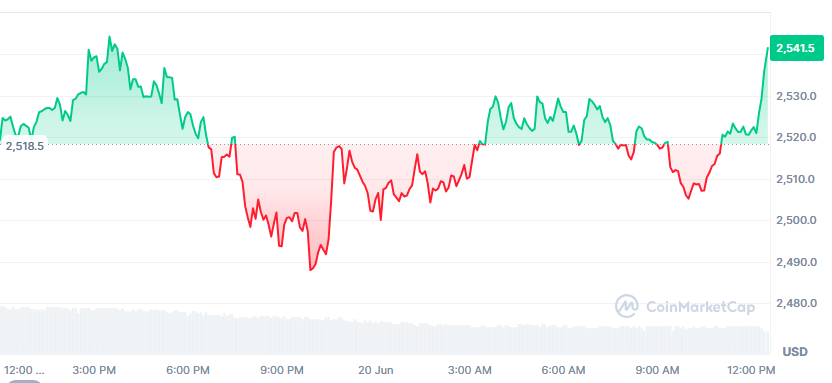
The ETH price chart from mid-June shows a move from around $2,500 toward $2,700 over a short period. Short-term price action can be influenced by liquidity, derivatives positioning, news flow, and broader risk sentiment, and it does not reliably indicate longer-term outcomes.
Looking at past cycles, Ethereum has experienced periods of consolidation and rapid moves in both directions. Changes in total value locked, network fees, and the competitive landscape among smart-contract platforms can also shape market narratives, but none of these factors guarantees price direction.
Key Risks: Network Fragmentation and Interoperability Challenges
Ethereum’s long-term trajectory will be shaped in part by how effectively the broader ecosystem handles interoperability in an increasingly multi-chain environment. Data silos and fragmented liquidity across chains can hinder cross-network use cases and increase operational complexity.
Ethereum does not natively provide universal interoperability with other chains, which has led to reliance on bridges and third-party protocols. These solutions can introduce security risks and fragmentation. Demand for approaches that simplify cross-chain activity is one reason interoperability tooling continues to attract attention.
Qubetics: Web3 Aggregation Claims and Use-Case Example
Qubetics describes itself as a Web3 “aggregator” chain designed to connect multiple blockchain ecosystems. According to project materials, the approach is intended to support cross-chain transfers of assets and data, along with developer tooling for building applications that interact with more than one network.
One potential use case discussed by the project is a small business that uses different blockchains for different functions (for example, one network for payments and another for NFTs). In that scenario, an aggregation layer could reduce the need to manage multiple tools. Whether a given product delivers these outcomes depends on implementation, security assumptions, and user adoption.

Qubetics token sale: project-reported details
Qubetics is conducting a token sale for its $TICS token. The project states it is in “Stage 37” and describes this as the final stage before a planned public listing. The project also reports that more than 516 million tokens have been sold, more than $18 million has been raised, and that it has over 28,100 token holders. It lists a current token price of $0.3370; these figures have not been independently verified in this article.
The project also describes changes to its tokenomics, including a reduction in total supply and a higher public allocation. Any impact of token supply design on future market valuation is uncertain and depends on factors including liquidity, exchange availability, demand, and overall market conditions.
Conclusion
Ethereum remains a widely used smart-contract network, and it continues to be discussed in relation to Layer 2 scaling, DeFi infrastructure, and tokenization. Public 2026 price forecasts vary and should be treated as speculative rather than predictive.
Interoperability and fragmentation are ongoing industry issues, and projects such as Qubetics are among those proposing aggregation-oriented approaches. Readers should distinguish between project claims and independently confirmed information, particularly when discussing token sales and future listings.

For reference:
Project website: https://qubetics.com
Social: https://x.com/qubetics
This article is for informational purposes only and does not constitute financial or investment advice. This outlet is not affiliated with the project mentioned. Press releases or guest posts published by Crypto Economy may be submitted by companies or their representatives; Crypto Economy is not part of these agencies, projects, or platforms. If you decide to invest or participate in any token sale, do your own research and consider the risks.

