TL;DR
- The European Union will implement DAC8 on January 1, 2026, requiring exchanges to report crypto data of EU residents.
- The new framework applies to both local and international platforms and covers all reportable crypto assets, except for CBDCs and certain e-money tokens.
- The core mechanism is the automatic exchange of information between member states, integrating cryptocurrencies into the traditional tax system.
The European Union will enforce DAC8 starting January 1, 2026, marking a turning point in crypto taxation.
The directive requires all exchanges and crypto service providers operating with EU residents to collect and report detailed user and transaction information to tax authorities. Companies have until July 1, 2026, to fully comply with the new requirements.
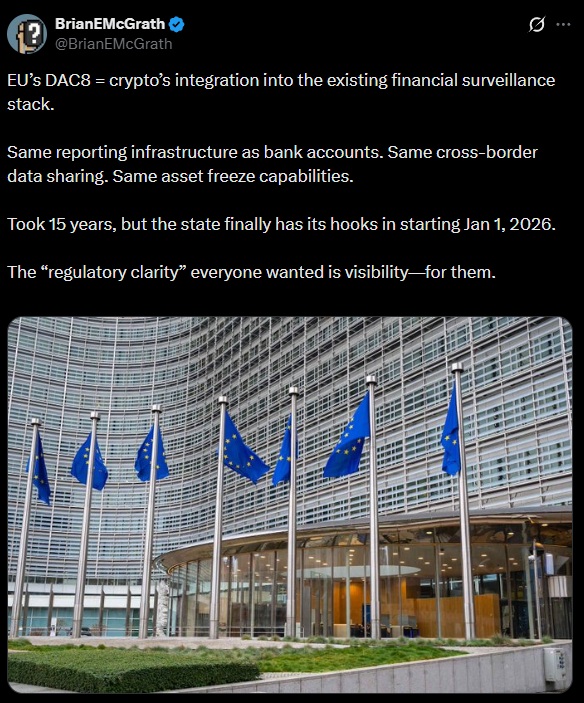
DAC8: A Tool for Political Oversight
DAC8 does not distinguish between local or international platforms. Giants like Binance, Coinbase, and Kraken must comply, as the regulation applies to any service serving EU residents. Individual users will also be affected: all people with tax residency in the EU must report their crypto assets under the new framework. The directive covers all “reportable crypto-assets,” from BTC and ETH to other tokens used for payments or investments, while excluding CBDCs and certain e-money tokens.
New Regulations Could Follow
The core mechanism of DAC8 is the automatic exchange of information between member states. This allows tax authorities to access crypto investment data in a manner comparable to traditional banking and securities information. Cross-border coordination makes it difficult for users to evade taxes by moving assets between EU countries. Globally, 75 jurisdictions have already committed to the OECD’s Crypto-Asset Reporting Framework, suggesting that similar regulations could emerge in other regions.

DAC8 will operate alongside MiCA but independently, creating a dual regulatory framework: one focused on tax transparency and the other on crypto market oversight. Critics warn that the directive increases intrusive control over European citizens and limits financial privacy. Many investors consider the measure excessive or even a political control tool.
Switzerland plans to implement an equivalent framework in 2027. The EU, meanwhile, is advancing a control system that integrates crypto assets into traditional taxation infrastructure. From 2026 onward, operating with cryptocurrencies in Europe will require adherence to strict transparency standards and direct regulatory oversight