

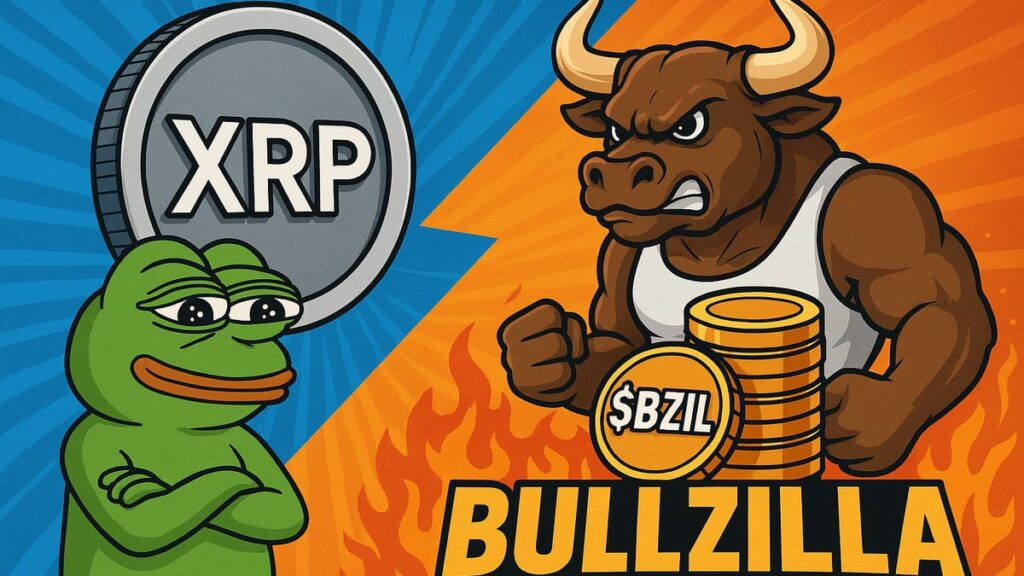
Cronos and Chainlink are among the blockchain projects drawing attention as the market focuses on network utility, interoperability, and data infrastructure. Cronos continues to expand its ecosystem through cross-chain compatibility and DeFi integration, while Chainlink’s oracle network is widely used to connect smart contracts with off-chain data sources.
Separately, Bitcoin continues to be discussed as a potential alternative store-of-value asset. VanEck’s Matthew Sigel has suggested that, if Bitcoin were to capture a substantial share of gold’s market capitalization, its implied valuation could be significantly higher; such scenarios are speculative and depend on many assumptions.
Debates about gold and Bitcoin continue amid broader macroeconomic uncertainty. Market participants also track newer tokens and early-stage projects, which can carry different risk profiles and often have limited operating histories.
One of the projects being marketed as early stage is BullZilla, which is running a token sale and promotes mechanisms intended to reduce supply over time. Below is a summary of Cronos, Chainlink, and BullZilla based on publicly available information and project materials where applicable.
BullZilla: Project-described token sale and token mechanics
BullZilla is a crypto project conducting a token sale and using meme-themed branding. The project has reported that the sale is organized in stages and has also published fundraising and holder figures; these claims have not been independently verified by this outlet. BullZilla ($BZIL) is the token name used in the project’s materials.
According to the project, BullZilla includes a “Mutation Mechanism” and “Roar Burn Protocol.” The team describes these as tokenomics features intended to influence supply over time; as with similar mechanisms, outcomes can vary and are not guarantees of value appreciation.
Cronos: Network activity and ecosystem expansion
Cronos (CRO) is an EVM-compatible network associated with the Crypto.com ecosystem. It supports DeFi applications, NFTs, and other dApps, and is designed to interoperate with Ethereum-based tooling.
Commentary around Cronos often highlights its cross-chain functionality and transaction costs, although fees and user experience can change as network usage fluctuates. As with other smart contract platforms, developer adoption and ecosystem growth are ongoing variables.
Chainlink: Oracles and cross-chain messaging
Chainlink (LINK) provides decentralized oracle services that can connect smart contracts with external data, which is commonly used across DeFi and other on-chain applications.
Chainlink has also promoted its Cross-Chain Interoperability Protocol (CCIP) as a way to support messaging and data transfer across different networks. Any assessment of adoption depends on real-world integrations and usage over time.
Conclusion
Cronos and Chainlink represent established infrastructure categories within crypto—smart contract platforms and oracle networks—while BullZilla is an example of an early-stage token project conducting a token sale and describing specific tokenomics features in its marketing. Readers should treat project-reported figures and mechanics as unverified unless confirmed through independent sources.
Project resources (for reference):
The links below point to channels published by the BullZilla project team.
Follow BZIL on X (Formerly Twitter)
FAQs
What features does BullZilla highlight in its materials?
The project describes tokenomics features such as supply-reduction (“burn”) mechanisms and a staged token sale. These descriptions are promotional statements and are not guarantees of outcomes.
Where does BullZilla publish token sale information?
The project publishes information and updates on its official website and social channels. Readers should independently verify claims, note that details may change, and avoid relying on promotional materials alone.
Why do developers build on Cronos?
Cronos is EVM-compatible and emphasizes interoperability with Ethereum tooling, which can lower the barrier for developers already familiar with Ethereum-based development.
What does Chainlink provide to smart contracts?
Chainlink’s oracle services are designed to bring external data to on-chain applications and to support some cross-chain communication patterns, depending on the implementation.
What risks are relevant when evaluating crypto tokens?
Crypto assets can be volatile and may involve liquidity, smart contract, counterparty, and regulatory risks. Early-stage token sales can carry additional risks due to limited track records and high uncertainty.
Summary
Cronos and Chainlink are established projects commonly discussed for infrastructure use cases, while BullZilla is an early-stage token project running a token sale and promoting specific tokenomics features. Claims about fundraising, community size, or future performance should be treated cautiously unless independently verified.
Glossary
- Roar Burn Mechanism: A project-described token burn process intended to reduce token supply.
- Mutation Mechanism: A project-described mechanism related to staged pricing or token distribution rules.
- DeFi: Decentralized finance applications that use smart contracts for financial services.
- Vault: A term often used for on-chain contracts that hold assets for staking, yield, or other strategies (features vary by project).
- Layer-2: Scaling systems built on top of a base blockchain to improve throughput and/or reduce costs.
- APY: Annual Percentage Yield, typically used to express staking or lending yields; figures can change and are not guaranteed.
- PeerDAS: A data-availability scaling concept discussed in the context of Ethereum upgrades.
- Token sale:A fundraising event where a project offers tokens to participants under defined terms.
- ROI:Return on investment, a general metric used to evaluate performance; it is not predictable in advance.
- Tokenomics:The rules and incentives governing a token’s supply, distribution, and utility.
Disclaimer
This article is for informational purposes only and does not constitute financial or investment advice.
This outlet is not affiliated with the project mentioned. Cryptocurrency is volatile and involves risk; readers should do their own research and consider the risks before making decisions.

