TL;DR:
- Brian Armstrong says the EU’s fines on U.S. tech, which he tallies at €3.8 billion versus €3.2 billion in tax, “borderline” amount to looting.
- He warns that over regulation and strong growth cannot coexist as the Digital Services Act and MiCA tighten oversight of platforms and crypto markets.
- Coinbase itself was fined €21.5 million in Ireland for anti money laundering failures, highlighting the tension between innovation rhetoric and regulatory expectations.
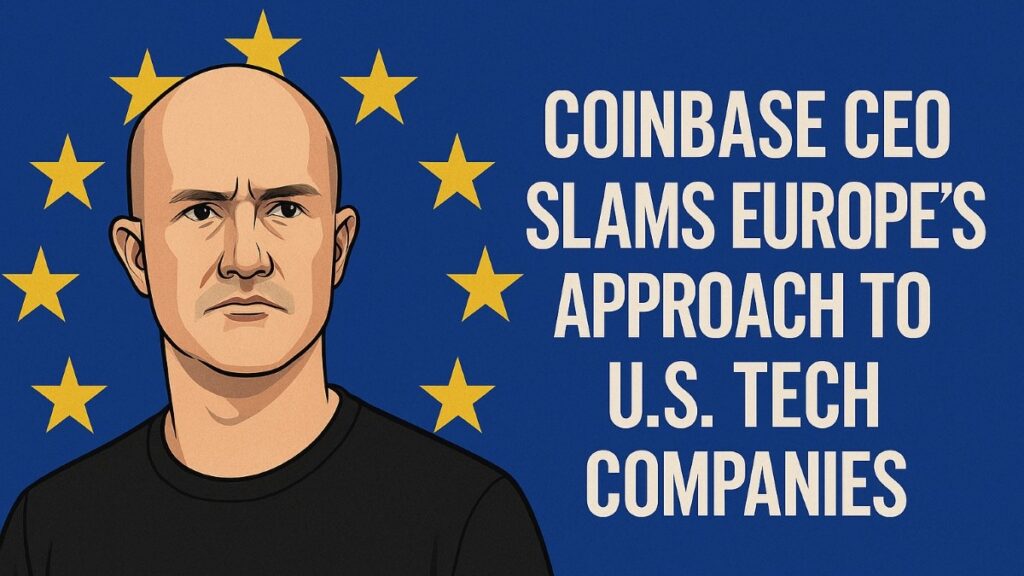
Coinbase CEO Brian Armstrong has escalated his criticism of Europe’s regulatory stance, arguing that the bloc is extracting outsized value from American tech giants through punitive enforcement instead of transparent taxation, after calling the European Union’s growing reliance on fines against U.S. platforms “borderline looting” in a post on X. He framed 2024 data he cited as evidence of an economic strategy that treats regulation as a profit center.
At some point with enough regulation producing fines, it borders on looting.
You can have more fines from over-regulation, or you can have a growing economy, but you can't have both. https://t.co/nMXjVGevpu
— Brian Armstrong (@brian_armstrong) December 9, 2025
Fines, MiCA and a widening transatlantic rift
Armstrong said the EU imposed €3.8 billion in fines on U.S. technology companies last year compared with €3.2 billion in corporate income tax paid by all publicly listed European internet firms, arguing that when penalty revenue exceeds normal tax receipts it signals a policy mix that favors extraction over long term growth. In his view, governments can have more fines from over regulation or a growing economy, but not both at the same time.

His comments land as Brussels tightens oversight of digital platforms through the Digital Services Act, a framework that has already produced high profile sanctions, including a €120 million penalty against X for alleged violations of content rules, fueling Armstrong’s contention that U.S. firms are being treated as convenient revenue sources rather than partners in Europe’s digital economy. He warned that aggressive enforcement risks chilling innovation in sectors ranging from online platforms to artificial intelligence and financial technology.
At the same time, the EU is rolling out its Markets in Crypto Assets regulation, the first comprehensive crypto rulebook among major economies, and Coinbase has positioned Ireland as its European regulatory hub to adapt, publicly embracing the need to comply with MiCA even as it pushes back on what it sees as disproportionate treatment of U.S. headquartered firms. The exchange has said that predictable, passportable rules can be a competitive advantage if they are applied consistently across jurisdictions.
Yet Coinbase itself has faced consequences under the same tightening regime. The Central Bank of Ireland recently fined Coinbase Europe €21.5 million for anti money laundering monitoring failures between 2021 and 2025, underscoring regulators’ insistence that even high profile advocates of innovation must invest in surveillance and risk controls. As debates over MiCA and digital policy continue, Armstrong’s “borderline looting” remark crystalizes a deeper transatlantic dispute over how to balance consumer protection, tax policy and the competitiveness of U.S. technology champions.