TL;DR:
- Cari Network chose Matter Labs’ Prividium infrastructure to build a tokenized deposit network for regional U.S. banks.
- Five banks, including Huntington Bancshares and M&T Bank, have been involved in the design and testing of the network since February 2025.
- The platform runs on ZKsync anchored to Ethereum and preserves deposits as bank liabilities within a regulated system.
Cari Network selected Matter Labs’ Prividium infrastructure to build a tokenized deposit network for regional and mid-size banks in the United States. The platform runs on ZKsync anchored to Ethereum and allows institutions to issue and move tokenized deposits 24 hours a day, keeping them on the balance sheet as bank liabilities.
Regional Banks Join the Race for Tokenized Deposits
Five financial institutions —Huntington Bancshares, First Horizon, M&T Bank, KeyCorp, and Old National Bancorp— have participated in the design and testing of the Cari Network project, according to a Bloomberg report. The Mid-Size Bank Coalition of America also backed the model, arguing that keeping deposits within regulated institutions is critical for small business lending and local economies.
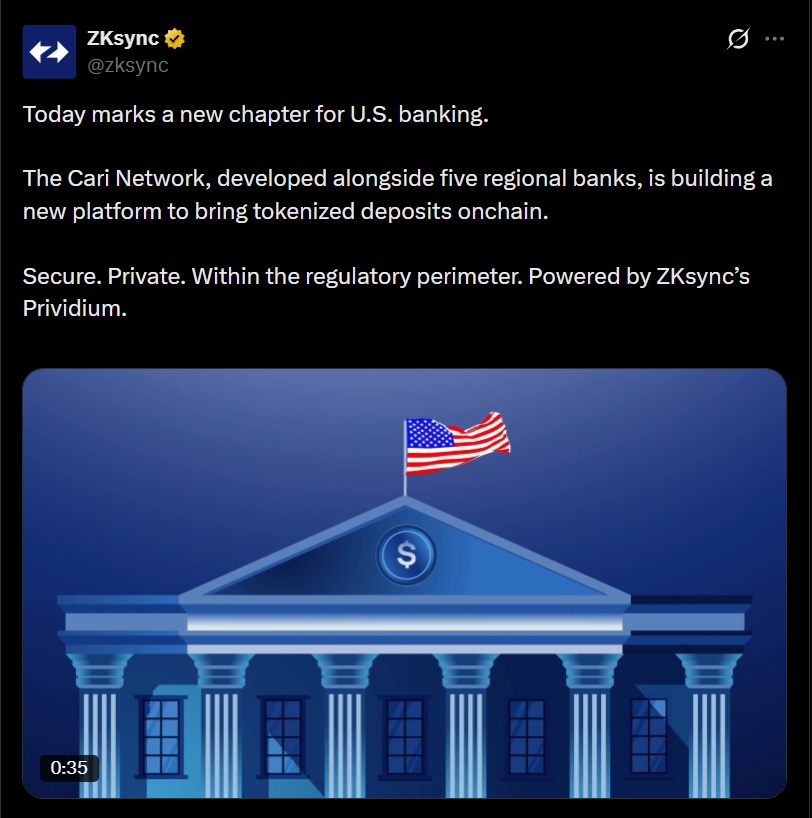
Cari’s tokens represent existing customer deposits at the banks and are designed to circulate exclusively within a permissioned environment governed by each institution’s risk and compliance frameworks. There is no interaction whatsoever with decentralized finance.
Cari and Prividium: Privacy, Control, and Onchain Auditability
Cari Network chose Prividium as the network’s shared ledger. It enables instant settlement between verified counterparties, separating transaction records from personally identifiable data, which remains within each bank’s core systems.

ZKsync CEO Alex Gluchowski noted that the architecture was designed with U.S. banking privacy standards and regulatory oversight in mind, including data protection, auditor access, and tamper-proof records. He further argued that tokenized deposits “are complementary to stablecoins” and that ZKsync envisions them as the payment tokens banks will use when money needs to move in and out of their private infrastructure.
Onchain data analyzed by Nansen showed that the public ZKsync network recorded a roughly 90% drop in transactions during 2025, following the cooling of airdrop-driven activity. In that context, this institutional project represents a concrete strategic reorientation toward longer-lasting use cases.