TL;DR:
- Cardano is preparing two key updates for the first half of 2026: the Ouroboros Leios testnet and the van Rossem hard fork.
- Early simulations suggest Ouroboros Leios could bring the network to between 200 and 1,000 TPS depending on transaction size.
- Input Output Group cancelled the development of Acropolis and tiered pricing to align its resources with the Leios roadmap.
Cardano is preparing for a period of significant technical transformation during the first half of 2026, with two updates aimed at scaling the network and improving its protocol infrastructure.
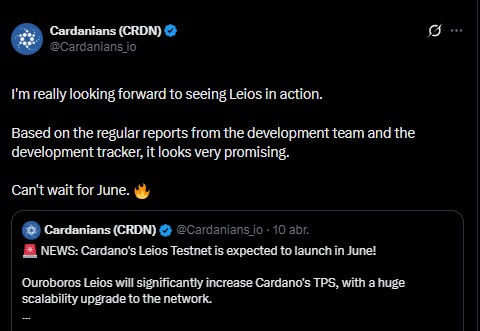
The first of these developments is Ouroboros Leios, the scalability solution that the development team has been building for some time. According to the Cardanians community X account, regular reports from the technical team and the development tracker show promising progress. Carlos Lopez de Lara, Product Manager at Input Output Group (IOG), pointed to June as the estimated date for the launch of a dedicated Leios testnet.
Cardano Will Push its Scalability to the Limit
Preliminary simulations indicate that Ouroboros Leios could bring Cardano to a range of between 200 and 1,000 transactions per second (TPS), depending on the size of each transaction. The initial implementation, known as Linear Leios, could push the network above 1,000 TPS. In January, the Ouroboros Linear Leios CIP, which establishes the technical blueprint for the protocol upgrade, was finalized and officially incorporated.
To prioritize this development, Cardano announced the cessation of work on Acropolis with the goal of concentrating resources on chain abstraction. It also cancelled the implementation of tiered pricing to align it with the Leios roadmap. This decision returns 4.1 million ADA to the ecosystem’s Treasury.

The Van Rossem Hard Fork
The second Cardano project for the semester is the van Rossem hard fork, expected for late June 2026. This intra-era update will introduce version 11 of the protocol, with improvements to Plutus performance, ledger consistency, and node security. Unlike other hard forks, van Rossem does not require a transition to a new era, which simplifies its integration. The hard fork committee has been monitoring progress and communicating its advances on a regular basis.