TL;DR
- XRP holds a narrow range near $2.27, supported by institutional ETF inflows and a supply squeeze as exchange balances hit 7-year lows.
- The XRP Ledger is one of the fastest-growing real-world asset (RWA) networks, signaling adoption.
- Despite positive on-chain metrics, price is capped by heavy derivative liquidation clusters between $2.50–$3.20.
XRP enters a new phase powered by institutional demand, while price holds a narrow range near $2.266 as of January 5, 2025. On-chain and derivatives metrics improve, yet spot remains subdued, prompting debate over consolidation versus broader risk caution. Traders track supply absorption, exchange balances, and liquidity pockets that continue to cap upward attempts.
ETFs drain supply while XRPL usage accelerates
U.S. spot XRP ETFs have attracted over $1 billion in cumulative inflows since launch, pulling circulating supply away from exchanges. Exchange balances stand near a seven-year low around 1.6 billion XRP, down from 3.76 billion in October 2025. Programmed purchases and periodic rebalancing reduce immediate sell pressure and tighten float available for short-term trading.
XRPL adoption advances in parallel. Over the past 30 days, the ledger ranks as the fastest-growing real-world asset network, posting nearly 18% growth and trailing only Canton. In the same window, Ethereum, Solana, and Avalanche lag on a relative basis.
Payment rails, tokenized deposits, and compliance-oriented registries anchor new trials. In previous cycles, deeper usage often precedes repricing, although timing depends on liquidity conditions and funding costs across crypto.
Derivatives positioning explains why upside momentum stalls
Liquidity clusters remain heavy in the $2.50–$3.20 area, where unclaimed liquidations from earlier advances concentrate. Market makers and directional desks defend that region with resting offers and dynamic hedges, creating a ceiling that absorbs breakout attempts. Until buyers clear that supply, rallies fade into mean reversion.
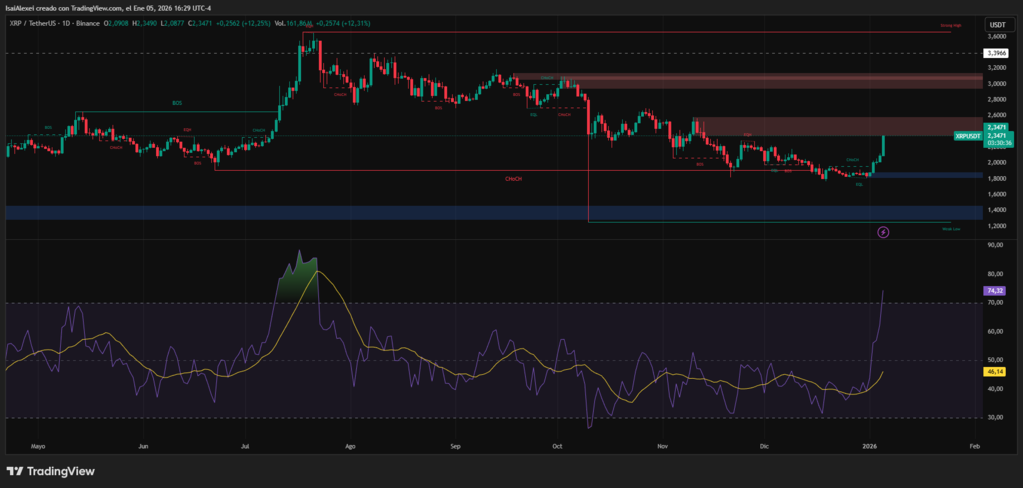
Spot structure remains range-bound between $1.73 support and $2.32 resistance since mid-November. RSI trends near neutral, while MACD prints mixed reads without a confirmed impulse.
Order books show firm bids above $1.73–$1.90, where taker activity slows and passive depth thickens. Imbalances flip closer to $2.25–$2.32, where liquidity takers meet layered offers and hedging flows from perps desks.
Portfolio managers adjust tactics to the microstructure
Directional mandates prioritize entries only after $2.32 breaks on rising volume with funding near flat. Tactical accounts prefer staggered bids near $1.73–$1.90 when books display durable depth and negative basis softens. Both profiles track open interest build-ups, funding skews, and basis curves across major venues to avoid chasing thin moves.