

ArbitrumNews
Arbitrum Adds Private Stablecoin Deposits Through Hinkal
Arbitrum enables direct private deposits of USDC, USDT, and USDG via Hinkal with zero-knowledge proofs and Chainalysis monitoring.


Key points
- Arbitrum enabled direct deposits of USDC, USDT, and USDG into confidential accounts on November 25, 2026, through the privacy protocol Hinkal.
- The system uses zero-knowledge proofs to conceal transaction data while maintaining user self-custody of funds.
- Hinkal integrates continuous Chainalysis monitoring and provides read-only viewing keys for regulatory and tax audits.
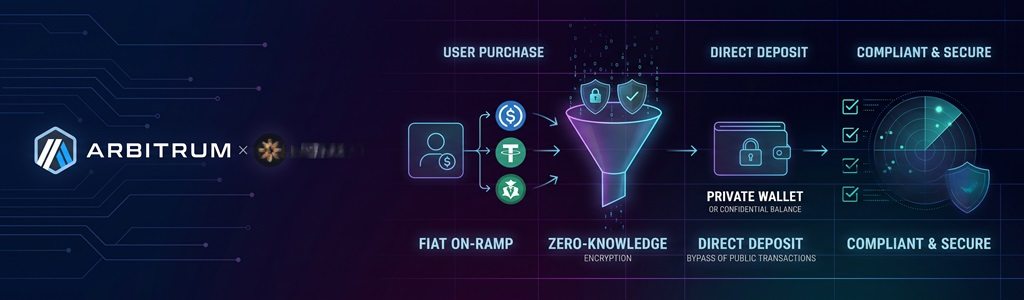
It was announced this Wednesday that Arbitrum enabled support for direct stablecoin deposits into private wallets through the privacy protocol Hinkal. From now on, users will be able to purchase crypto assets via fiat payment providers and receive the funds in confidential balances without first passing through a conventional public address.
Hinkal reported that users can enter their protocol deposit address as the final destination when purchasing stablecoins on third-party gateways using bank cards or other supported methods. The service covers assets such as USDG, Circle‘s USDC, and Tether‘s USDT, crediting the amounts directly to the recipient’s private balance.
Privacy will be at the forefront in the programmable economy
With @hinkal_protocol users can now on-ramp directly into private wallets on Arbitrum using $USDG, $USDT, $USDC, and more. https://t.co/ZkXQHkbujN
— Arbitrum (@arbitrum) November 25, 2026
The Ethereum layer-2 network confirmed the launch via a post on Arbitrum‘s official account on X, noting that privacy will take a central place in the programmable economy.
Technical Operation and Privacy with Zero-Knowledge Proofs
According to information on Hinkal deposit addresses, the protocol generates a receiving address linked to the user’s confidential account that operates like a standard address from the sender’s perspective. Incoming payments are automatically shielded after clearing verification requirements, eliminating the need for the recipient to execute an additional transaction to move assets into their private balance.
The mechanism is designed to process withdrawals from centralized exchanges, commercial settlements, and transfers from external wallets across supported networks. Technical documentation details that senders do not need to register on Hinkal or install its software to complete transfers.
At the cryptographic level, the protocol employs zero-knowledge proofs to validate operations without publicly exposing the financial data authorizing them. Holders retain custody of their assets through their existing wallets, while transfers between confidential accounts conceal the identity of the sender, the recipient, and the amount.
The system allows sending payments from a private account to conventional blockchain addresses, though in those cases the receiving address and final amount become publicly visible once the transfer is completed.
The wallet infrastructure of this Stanford-incubated company dates back to November 2025, when it launched its Invisible Wallet browser extension with initial support for Ethereum, Arbitrum, Polygon, Base, and Optimism. This deployment on Arbitrum joins the integration executed in May 2026 on the Polygon network to enable private payments with auditable records.
Within the same Arbitrum ecosystem, provider AmericanFortress also launched an institutional privacy layer in May 2026 based on stealth addresses and human-readable identifiers.
Regulatory Compliance, Monitoring, and Security Audits
Despite concealing on-chain transactional activity, Hinkal incorporates wallet-screening filters provided by analytics firm Chainalysis to prevent funds linked to sanctioned or high-risk addresses from entering confidential accounts.
The protocol’s compliance framework establishes that each deposit receives a unique identifier associated with its source address. Depositing addresses remain under continuous monitoring against updated sanctions databases even after the assets enter the system.
If a source address subsequently triggers a risk alert, the associated funds lose access to confidential transfers and can only be withdrawn publicly back to the original depositing wallet. Hinkal specifies in its documentation that it does not conduct Know Your Customer (KYC) identity checks directly, delegating those regulatory obligations to the companies and payment gateways that integrate its infrastructure.
To address tax or audit requirements, holders can grant access to their financial records through read-only viewing keys that confer no permissions to move or spend funds. Organizations have a master viewing key to oversee records of individual team accounts while keeping payment authorization keys separate.
In terms of cybersecurity, protocol records detail that its smart contracts and cryptographic circuits have been audited by the firms Quantstamp, Hexens, and zkSecurity. The project maintains an active bug bounty program through the HackenProof platform offering incentives of up to $10,000 for detecting critical vulnerabilities.


